
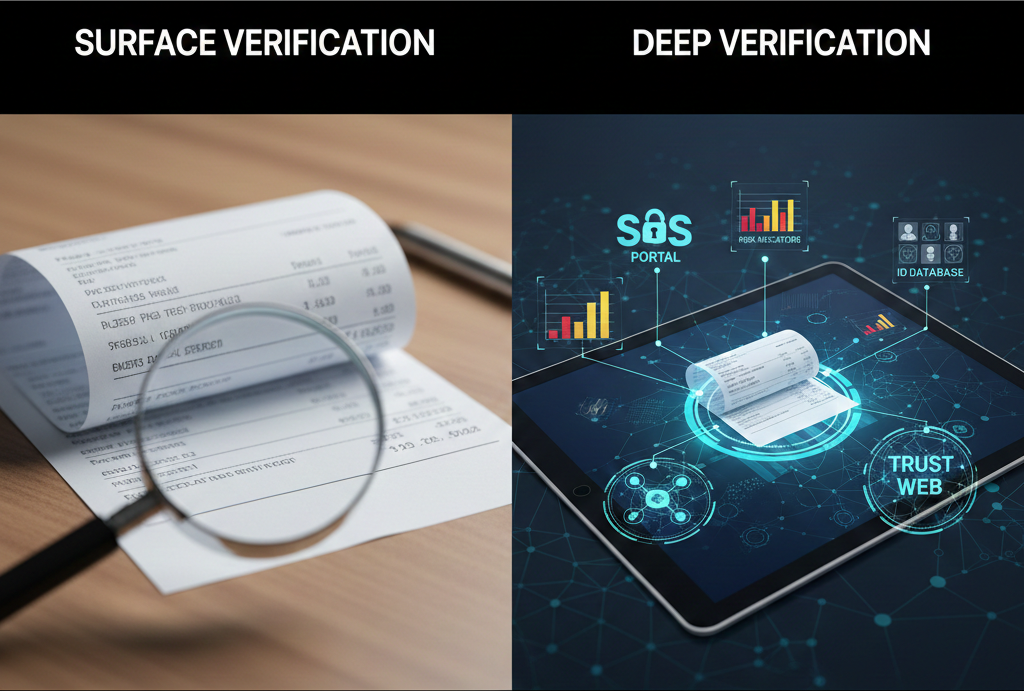

A loan officer at a consumer finance company in Manila reviews an application from a call center agent. Monthly income: ₱35,000. The applicant uploads a payslip PDF.
An AI agent processes it automatically. Payslip verified. Income extracted. Loan approved in eight hours.
Three months later, the loan defaults. The payslip was real—but it was from a side job the applicant worked for two months before applying. Her primary income? Half of what she claimed. The AI agent never cross-checked the payslip income against her SSS contribution history, which would have shown the discrepancy immediately.
Here's the thing: you're not actually afraid of AI making decisions. You're afraid of AI making decisions based on data it never verified deeply enough in the first place.
And as AI shifts from tool to agent—from something you ask to something that acts on your behalf—the question becomes: How do we give AI agents a trust baseline strong enough that they're not approving loans based on documents that look real but tell incomplete stories?
I'm going to share what agentic AI actually is, why the trust problem in the Philippines (and markets like it) isn't about continuous monitoring—it's about verification depth at origination—and the infrastructure layer that makes AI decisioning defensible.
What Agentic AI Actually Means (And Why Verification Depth Matters More Than Speed)
Let's clear up the terminology first, because "agentic AI" sounds like something out of a tech keynote, not your lending operations in Quezon City.
Here's the distinction that matters:
AI as a tool: You ask it a question, it gives you an answer. You review a loan application, you ask the AI to extract data from a payslip, it returns the income figure. You're still deciding whether to approve.
AI as an agent: It acts on your behalf. It extracts income from the payslip, cross-references it with government contribution records, checks for overleveraging signals across other lenders, verifies the borrower's identity through face matching, flags any blacklist warnings, and auto-approves or rejects the application—before a human loan officer ever sees it.
The shift is from "Can we trust the AI's output?" to "Can we trust that the AI verified the inputs deeply enough before making the decision?"
You're already seeing this in Philippine financial services:
- AI agents processing loan applications end-to-end for BPO employees, retail workers, and salaried staff
- AI agents auto-approving or rejecting based on extracted document data, risk scores, and identity verification
- AI agents flagging fraud patterns—multiple loan applications, blacklist matches, income-contribution mismatches
The technology is deployed. The question is whether the verification depth underneath the AI is sufficient—or whether you're approving loans based on surface-level document checks that miss the fraud hiding in plain sight.
Let me show you what happens when verification depth is too shallow.
Before/After: The Overleveraging Blind Spot
Before: A digital lender in Metro Manila used an AI agent to process loan applications. The agent extracted data from uploaded payslips using OCR, verified government IDs with face matching, and calculated debt-to-income ratios based on declared income.
Processing time dropped from 48 hours to 6 hours. Approval rates climbed from 58% to 74% as borrowers no longer abandoned applications during long wait times.
After: Default rates spiked by 29% within the first year. When the lender investigated, they discovered a pattern: over 40% of defaults came from borrowers who were already overleveraged at the time of approval—they had 3-5 active loans from other lenders that weren't declared on the application.
The AI agent had no way of knowing. It verified the documents the borrower provided. It didn't check what the borrower didn't provide.
The insight: Speed without verification depth isn't innovation. It's risk you can't see until it defaults.
The AI agent did exactly what it was designed to do—process documents quickly. But it was verifying what borrowers uploaded, not what borrowers were hiding. And in a market where digital lending has exploded and borrowers can apply to 5-10 lenders in a single day, overleveraging is invisible unless you check for it.
Why the Old Trust Models Don't Work for Agentic AI in the Philippines
I hear this from lenders across the Philippines: "We verify payslips, IDs, and bank statements at onboarding. Why isn't that enough?"
Here's the truth: Traditional verification checks the documents borrowers choose to show you. It doesn't check the information they're choosing to hide.
An applicant uploads a payslip showing ₱35,000 monthly income. Your AI agent extracts the figure, verifies the document format looks legitimate, and calculates affordability. Loan approved.
But here's what the AI didn't check:
- Does the payslip income match their SSS contribution history? (SSS contributions are based on declared salary—if contributions reflect ₱20,000 but the payslip says ₱35,000, something's wrong)
- Is this borrower already overleveraged? (Have they applied to 4 other lenders in the past 30 days? Do they have existing loans they didn't declare?)
- Is the government ID valid? (Does the ID number exist in government databases, or is it fabricated?)
- Does the income pattern make sense? (Does the payslip show employment at a company that matches their PhilHealth or Pag-IBIG records?)
Your AI agent approved the loan based on what it could see. It had no way of checking what it couldn't see.
And in the Philippines, where digital lending competition is fierce, borrowers know they can apply to multiple lenders simultaneously, uploading the same (or slightly modified) documents to each one, hoping to get approved before the overleveraging is discovered.
By the time you find out they have five other active loans, they've already defaulted on three of them.
Objection #1: "Can't we just ask borrowers to declare all existing loans?"
I understand the instinct. Add a field on the application: "List all existing loans." Require borrowers to self-report debt obligations.
But here's the problem: Borrowers who are overleveraged lie. Not always maliciously—sometimes they genuinely forget a small loan from six months ago, or they don't consider a "cash advance" from another app to be a "real loan."
And borrowers who are committing fraud? They're certainly not going to declare loans that would disqualify them.
A fintech lender in the Philippines tried this. They added a mandatory field: "Do you have other active loans? If yes, list them." They required borrowers to upload proof of existing loan statements.
Compliance was inconsistent. Borrowers who were overleveraged simply checked "No" and moved on. The lender had no way of verifying whether the declarations were true unless they manually called other lenders (which they couldn't do at scale).
The insight: Asking borrowers to self-report risk is like asking a job applicant to list their own weaknesses. You'll get the answer that helps them get approved, not the answer that protects you.
The Real Problem (Reframe)
The issue isn't that you don't have enough data at approval. It's that you don't have verified, cross-referenced data from sources the borrower can't manipulate.
Right now, your AI agent is making decisions based on:
- Documents the borrower uploads (payslips, IDs, bank statements)
- Information the borrower declares (income, employment status, existing debts)
- Data points the borrower controls (which documents to show, which to hide)
What's missing is data from sources the borrower doesn't control—government contribution records (SSS, PhilHealth, Pag-IBIG), cross-lender overleveraging signals, blacklist databases, logic checks that verify document authenticity against official records.
That's not a feature you can bolt on. It's infrastructure.
The Three Trust Gaps in Agentic AI for Philippine Lenders
When an AI agent approves a loan on your behalf, there are three questions you need to answer with certainty:
Gap 1: Identity Trust
Is the person behind the application who they claim to be?
Your AI agent verifies this with a government-issued ID and a selfie match. That works for basic KYC.
But here's what it doesn't catch:
- Fabricated ID numbers: The ID looks real, but the number doesn't exist in PhilSys, SSS, or other government databases.
- Stolen identities: The ID and selfie match, but the person applying isn't the person who owns the ID—they borrowed it from a family member or bought credentials from someone desperate for cash.
- Synthetic identities: The ID is real, but the employment and income information attached to it is fabricated or inflated.
Your AI agent checked that the face matches the ID. It didn't check that the identity is legitimate and matches government records.
What's missing: Cross-referencing ID numbers with government databases (SSS, PhilHealth, Pag-IBIG) to confirm the identity exists and matches the claimed employment/income profile. Face matching alone isn't enough—you need to verify the identity behind the face.
Gap 2: Data Trust
Is the income and employment data the borrower is providing actually accurate?
Even if the identity is real, the income claim might not be. A borrower uploads a payslip showing ₱40,000 monthly income. Your AI agent extracts the figure and uses it to calculate affordability.
But here's the thing: In the Philippines, payslips can be:
- Real but outdated (from a previous job or a contract that ended)
- Real but incomplete (showing only one income source when the borrower has multiple part-time jobs)
- Real but inflated (edited PDFs that pass OCR but don't match actual payroll records)
- Real but inconsistent with government records (claiming ₱40K income but SSS contributions reflect ₱22K salary base)
In my experience building brand and AI systems, this is where most lenders in emerging markets get blindsided. They trust document authenticity (the payslip looks real) without verifying data consistency (does the income match government contribution records?).
What's missing:
- Cross-referencing payslip income with SSS/PhilHealth/Pag-IBIG contribution records (borrower-permissioned access to verify declared income matches contribution history)
- Logic checks on extracted document data (does employment tenure make sense? Do dates align? Are there red flags in formatting?)
- Database lookups for ID validation (does the government ID number exist in official records?)
Gap 3: Intent Trust
Is the borrower acting in good faith, or gaming the system?
This is the hardest gap to close because it's behavioral. A borrower might have a real identity and legitimate income—but they're applying to five lenders simultaneously, hoping to stack loans before any of them catch on.
Or they're on their third loan cycle in six months—borrowing, defaulting, borrowing again under slightly different details.
Or they're part of a fraud network where multiple applicants are using devices and IP addresses that trace back to the same location.
Your AI agent can't detect this unless it has context beyond the single application. It needs signals that show:
- Overleveraging risk: Is this borrower already carrying multiple active loans from other lenders?
- Blacklist status: Has this borrower been flagged by other lenders for fraud or default?
- Behavioral red flags: Are they applying to multiple lenders in rapid succession? Are their documents inconsistent across applications?
What's missing: Cross-platform risk intelligence that aggregates signals from multiple lenders, fraud databases, and behavioral patterns to flag intent risk before approval.
"Your AI agent can approve a loan in six hours. But if it only takes six minutes for a fraudster to apply to ten lenders with the same fake documents, speed without depth is a liability, not an advantage."
What Changes When You Build Verification Depth Into AI Decisioning
Let me paint the picture of what becomes possible when your AI agent has access to deep, cross-referenced verification at the moment of approval.
Faster decisions without higher fraud risk. Your AI agent acts confidently because it's not just checking documents—it's verifying them against government records, cross-lender data, and logic checks that catch inconsistencies borrowers thought were invisible.
Catch overleveraging before approval, not after default. When a borrower has applied to four other lenders in the past 30 days, your system knows before you approve—not six months later when they've defaulted on all five loans simultaneously.
Reduce fraud losses from document manipulation. Real-time logic checks and database lookups catch inflated income claims, fabricated ID numbers, and payslips that don't align with government contribution records.
Approve more legitimate borrowers with confidence. When you can verify income through SSS contribution history (borrower-permissioned), you don't have to reject applicants just because their payslips look "too good to be true." You can confirm they're real.
Before/After: The SSS Verification Layer
Before: A consumer lender in the Philippines approved personal loans based on uploaded payslips, government IDs, and self-declared income. Their AI agent processed applications quickly—average approval time was 8 hours.
But fraud losses were climbing. Investigators found that 34% of fraudulent applications involved income inflation—borrowers claiming ₱40K-50K monthly salaries but actually earning ₱20K-25K. The payslips looked legitimate. OCR extracted the figures correctly. But the income claims were fabricated or exaggerated.
The lender had no way of verifying income against an independent source. They were trusting documents the borrower controlled.
The intervention: The lender integrated borrower-permissioned SSS account linking. Applicants consented to share their SSS login credentials, and the lender's system scraped their contribution history directly from the SSS portal.
SSS contributions are based on declared salary. If a payslip claimed ₱45,000 monthly income but SSS contributions reflected a ₱24,000 salary base, the system flagged the discrepancy automatically.
After: The lender caught income inflation before approval. Fraud losses from inflated income dropped by 41% in the first year. And here's the unexpected benefit: approval rates for legitimate borrowers increased by 12% because loan officers were more confident approving applications that had been cross-verified against government records.
The insight: The income data was always available in government systems. What was missing was a way to access it with borrower permission at the moment of decisioning.
The Infrastructure Layer: What Philippine Lenders Actually Need
In my experience building brand and AI systems, the companies that win in the agentic AI era don't just make their AI faster. They make it more trustworthy by giving it access to verification sources the AI can't fake and borrowers can't manipulate.
Here's what that looks like for lenders in the Philippines:
1. Borrower-Permissioned Government Account Linking
Integrate an SDK that allows borrowers to link their SSS, PhilHealth, and Pag-IBIG accounts directly at application. The borrower provides their credentials, and your system scrapes their contribution history, employment records, and income data from the government portals.
This gives your AI agent access to:
- SSS contribution history (verifies declared income matches contribution levels)
- PhilHealth records (confirms employment and active contributions)
- Pag-IBIG contribution data (cross-checks employment tenure and income consistency)
Example: A borrower claims ₱38,000 monthly income on their application and uploads a matching payslip. Your AI agent requests permission to link their SSS account. The borrower consents. Your system scrapes their SSS record and discovers contributions reflect a ₱22,000 salary base. The discrepancy is flagged. The loan officer reviews manually. The application is declined, preventing a fraud loss.
Key point: This is a one-time data pull at origination—not continuous monitoring. But it gives your AI agent a trust baseline that documents alone can't provide.
2. Risk Indicators API (Overleveraging & Blacklist Signals)
Integrate a risk intelligence layer that aggregates data from multiple sources to flag overleveraging, blacklist warnings, and fraud patterns.
Your AI agent checks:
- Overleveraging signals: Has this borrower applied to multiple lenders recently? Are there signs of credit stacking?
- Blacklist databases: Has this identity been flagged by other lenders for fraud or default?
- Behavioral risk patterns: Are there red flags in application timing, device fingerprints, or document submission patterns?
Example: A borrower applies for a ₱30,000 loan. Your AI agent runs a risk footprint check and discovers the borrower has applied to four other digital lenders in the past 14 days. The overleveraging signal triggers a manual review. Upon investigation, the borrower already has three active loans totaling ₱85,000. The application is declined, preventing a near-certain default.
Key point: You're not monitoring employment status over time. You're catching behavioral risk at origination—before the overleveraging turns into default.
3. Document Intelligence (Payslip & Tax Document Extraction + Logic Checks)
Use AI-powered document processing that doesn't just extract data from payslips and tax documents—it verifies the data through logic checks and database lookups.
Your AI agent:
- Extracts income, employment dates, employer name from payslips and tax forms (OCR)
- Runs logic checks: Do employment dates make sense? Is the employer name formatted consistently? Are there formatting anomalies that suggest document editing?
- Cross-references extracted data with government account data (if linked) to verify consistency
Example: A borrower uploads a payslip claiming employment at "ABC Corporation" with ₱35,000 monthly income. Your AI extracts the data, then cross-checks it against the borrower's PhilHealth records, which show contributions from "XYZ Inc" (a different employer). The inconsistency is flagged. Manual review reveals the borrower uploaded a payslip from a previous job. The loan is declined.
Key point: Document extraction alone isn't enough. Logic checks and cross-referencing catch manipulation that OCR misses.
4. eKYC (Face + ID Matching)
Verify borrower identity through biometric face matching against their government-issued ID.
Your AI agent:
- Compares the selfie submitted by the borrower to the photo on their government ID
- Flags mismatches or low-confidence matches for manual review
- Integrates with database lookups (when available) to verify the ID number exists in official records
Example: A borrower submits a government ID and a selfie. Your AI agent runs face matching and returns a confidence score of 97%—strong match. The AI also checks the ID number against government databases and confirms it exists and is valid. Identity verified. The application proceeds.
Key point: Face matching confirms the person matches the ID. Database lookups confirm the ID itself is legitimate.
"Trust infrastructure for agentic AI isn't about monitoring borrowers forever. It's about verifying deeply enough at origination that your AI isn't approving loans based on stories borrowers want you to believe."
Objection #2: "Won't borrowers resist sharing their SSS or PhilHealth credentials?"
I get it. Asking borrowers to share government login credentials feels invasive. You're worried about adoption friction, privacy concerns, and regulatory compliance.
But here's the reality: Borrowers who are acting in good faith don't resist verification. They welcome it.
In markets where overleveraging and fraud are rampant, legitimate borrowers are competing with fraudsters for loan approvals. When you implement deeper verification, you're not punishing honest borrowers—you're giving them an advantage.
A digital lender in the Philippines integrated borrower-permissioned SSS linking and tracked adoption. Over 78% of applicants consented to link their SSS accounts when presented with the option. The messaging was simple:
"Link your SSS account to verify your income instantly. This helps us approve your loan faster and offer better rates to verified borrowers."
Borrowers understood: verification = faster approval + better terms. The 22% who declined? Many were attempting fraud or income inflation.
The insight: Honest borrowers see verification as protection. Fraudsters see it as an obstacle. If your adoption rates are low, you're either not explaining the value clearly—or you're attracting the wrong borrowers.
Where to Start: A Plan for Philippine Lenders
You don't need to rebuild your entire verification stack overnight. Start here:
1. Audit your current fraud and default patterns
Where are your losses coming from?
- Income inflation? (Borrowers claiming higher salaries than they actually earn)
- Overleveraging? (Borrowers with multiple undeclared loans defaulting simultaneously)
- Fabricated documents? (Payslips or IDs that look real but don't match government records)
- Identity fraud? (Stolen or synthetic identities)
Map your fraud and default data from the past 12 months. Identify the top 3 sources of losses. Those are your highest-ROI areas for deeper verification.
2. Start with SSS account linking for high-value applications
You don't need to implement borrower-permissioned verification for every loan. Start with your highest-risk, highest-value segment.
Pilot approach:
- Require SSS account linking for loans above ₱30,000 or for borrowers with income claims above ₱40,000 (where inflation risk is highest)
- Make it optional but incentivized for smaller loans ("Link your SSS for faster approval")
- Track adoption rates, fraud detection rates, and approval confidence
Measure the impact on fraud losses and approval accuracy. If SSS linking reduces fraud by 30-40% in the pilot segment, expand it.
3. Layer in risk footprint checks for all applications
Overleveraging detection is low-friction and high-impact. Integrate a risk indicators API that checks:
- Has this borrower applied to multiple lenders recently?
- Are there blacklist warnings associated with this identity?
- Are there behavioral red flags (device, IP, timing patterns)?
These checks take seconds and require no borrower action. They catch fraud your AI agent can't see from documents alone.
4. Implement document logic checks for payslip verification
Even without SSS linking, you can improve document verification by adding logic checks:
- Do employment dates make sense? (e.g., "employed since" date isn't in the future)
- Is the employer name formatted consistently? (e.g., not random characters or obvious typos)
- Does the income figure align with typical salaries for the claimed job title and industry?
These checks won't catch every fraud attempt, but they'll flag obvious anomalies for manual review—reducing your AI agent's exposure to low-quality data.
The Final Word
I know this feels like a bigger shift than it is. You're not being asked to slow down approvals or add friction to legitimate borrowers. You're being asked to give your AI agent the verification depth it needs to approve loans confidently—because right now, it's approving based on what borrowers show you, not what they're hiding from you.
The truth is, the banks and lenders that win in the Philippines over the next five years won't be the ones with the fastest AI. They'll be the ones whose AI makes decisions on verified, cross-referenced data that borrowers can't manipulate.
Because when an AI agent is approving loans on your behalf—extracting income from payslips, verifying IDs, calculating risk—the question isn't "Is the AI fast?" It's "Did the AI verify deeply enough that we're not approving loans based on stories borrowers want us to believe?"
That's not a question your AI can answer on its own. It's a question your verification infrastructure answers for you.
If you're a bank, lender, or financial institution in the Philippines serving salaried employees—and you're wondering how to make agentic AI decisioning safe without sacrificing speed or creating borrower friction—let's talk.
We've built the verification infrastructure that gives AI agents the trust baseline they need. We provide an SDK for borrower-permissioned SSS, PhilHealth, and Pag-IBIG account linking. We aggregate risk indicators that flag overleveraging, blacklist warnings, and fraud patterns. We offer eKYC with face and ID matching. We extract and verify data from payslips and tax documents through logic checks and database lookups.
Book a consultation, and we'll walk through exactly how it works for your use case. We'll show you where your verification gaps are, how to close them without adding borrower friction, and what becomes possible when your AI is making decisions based on verified data—not just documents that look real.
Your AI can approve loans in hours. But if it only takes minutes for fraudsters to apply with fabricated documents, speed without verification depth is a liability.
Stay human. Scale smart.