

These checks happen behind the scenes, but they shape who gets access to credit. A borrower can complete an application in minutes and still wait days while a lender checks documents or resolves conflicting information. Someone with a steady income and a limited credit history can be hard to assess if the lender has no reliable way to verify what they earn.
That’s the gap I mean when I talk about fintech rails. My original e27 article
What we pitched in Singapore
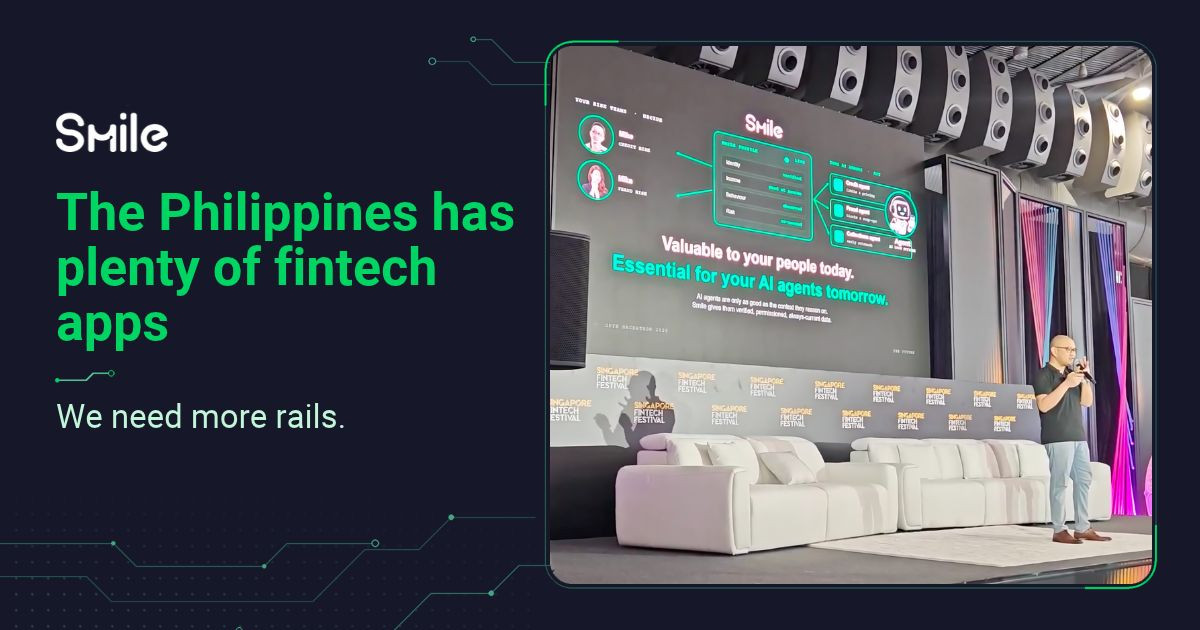
At SFF, we pitched Smile API as a finalist in the Global FinTech Hackcelerator. We took on a challenge from GXS Bank to build an adaptive risk model that assesses credit and fraud together and learns as patterns change. Singapore FinTech Festival · Global FinTech Hackcelerator
Credit and fraud teams ask different questions, but they often need the same information. An applicant’s income matters to a credit team assessing whether they can afford a loan. If that income can’t be verified or conflicts with other information, the fraud team may want a closer look. Bringing those signals together gives both teams a fuller picture and helps them decide which cases need further review.
The Singapore organisers were terrific hosts, and we learned a lot in the workshops, especially from GXS Bank, our challenge sponsor. At the finalists’ gala dinner, I had a chance to compare notes with officials from the Global Finance & Technology Network and the Monetary Authority of Singapore on how fintech is developing in Singapore and the Philippines.
What better rails could mean for Philippine borrowers
Those conversations brought me back to The Philippine Fintech Stack. Credit goes to Ray Alimurung and his partners at Kaya Founders for mapping the infrastructure gaps that shape what fintechs can build in the Philippines. Their work helped frame my thinking about where Smile API can contribute. Ray Alimurung · Kaya Founders
At Smile API, we’re building data rails that let fintechs and digital banks bring together credit and fraud signals with verified identity and income data. For someone with a limited credit history, verified income can give a lender more evidence to work with. For an application with conflicting information, those same rails can help the lender see what needs a closer look.
That’s how I see better risk modelling contributing to financial inclusion. If a lender can verify more of a borrower’s financial circumstances, more people get a chance to be assessed on evidence that reflects their ability to repay.
AI agents need that context too
AI agents were one of the big topics at SFF this year. In lending, a practical use for an agent is pulling together the relevant evidence, showing which details have been verified, and flagging what still needs review.
Take an application where the declared income differs from a verified record. An agent could surface the discrepancy, show the source and date of the record, and route the case to a reviewer. How useful that agent is depends on the quality of the data it can access and whether the reviewer can trace the information back to its source.
I’m looking forward to seeing what next year brings for fintech in the Philippines and around the world. There’s a lot of work ahead on the rails that will support better lending decisions and give AI agents reliable data to work with. Interesting times to be building in this space.