

- September 29, 2022
- September 29, 2022
Why API brings win-win solutions to challenges in the blooming Philippines freelance market
It's incredible that in just a short span of time, traditional freelancers and gig workers in the Philippines have rapidly become a force to be reckoned with in today's global freelance industry. The gig economy in the Philippines was, in fact, already rising a few years ago. The pandemic even accelerated this trend, increasing the ranks of Filipino freelancers in 2020-21, according to The Philippines Freelance Market 2022 Report by American cross-border payment platform Payoneer and Filipino micropayment service firm, Gcash. - Though the overall population of Filipino freelancers has yet to be determined, up to 1.5 million Filipinos were cited to be freelancing overseas. Creative Economy Council of the Philippines (CECP) President Paolo Mercado said these freelancers are on international online platforms for freelancing services, most of which constitute creative work, including web design and multimedia content and editing. Amplifying further the Philippines' gig economy was the recent partnership between Payoneer and Gcash meant to enable freelancers to access global clients and payments in foreign currencies from anywhere in the world to one consolidated place. Remarkable enough, but there's another exciting reality about all these developments. And this is about the existence of an "invisible bridge" between fintech companies, financial institutions, freelancers, gig workers, online sellers, and digital entrepreneurs. This bridge, called API or Application Programming Interface, can also be likened to a "glue that links technologies." Here are some of the challenges in the gig economy that an API can help resolve: Secured, real-time payouts Gig economy workers rely on payment platforms, and having highly secure and accessible platforms are primary considerations, followed by transaction fees and the convenience of transferring to bank accounts. Financial institutions can make their online apps more accessible by applying APIs in their system, which involves automating data exchange methods, processes, and workflows. - Credit scoring API usage by companies opens a wide variety of opportunities for freelancers and gig economy workers to attain credit and access to lending products. Companies like Smile API can customize this single API to make accurate data available on e-wallets, e-commerce, and delivery platforms. It can also serve as alternative credit data for traditional sources of proof of income. Underserved segments of the workforce can gain access to financial services by allowing them to share their gig and freelance work history and earnings much more efficiently to prove their financial capacity. Overall, this is how the Open Finance framework works as it deals with financial data as a whole, which is more holistic than its predecessor, Open Banking, which only involves banking data. Gig worker credibility Another significant challenge gig workers face in freelancing is getting employers or clients to present their credibility through employment information to applicable institutions. Smile can address this through a single API that is focused on employment data. Smile's API, for instance, provides instant access to the user's identity, employment, and income data from employment documents, HR and payroll systems, and social security systems, including gig economy platforms. Recruitment processing Companies can also achieve faster and more seamless recru
- September 29, 2022
- September 29, 2022

- August 31, 2022
- August 31, 2022
Investing in the Future of Finance: What Smile Contributes and Will Contribute to the FinTech Industry
In recent times, Financial Technology or FinTech has become well-known for its fast-paced innovations in FinTech markets: Financing, Asset Management, and Payments. As the worldwide FinTech market is expected to reach $16,652.68 billion by 2028, it is crucial to stay abreast of the most recent financial service delivery techniques. Following this, it is essential for lending institutions to consistently adopt new approaches and gradually migrate from traditional to alternative data. Smile API utilizes this strategy for lending institutions and provides an API that enables borrowers to communicate employment and income information with lenders effortlessly. Lending institutions will no longer have to undergo lengthy onboarding procedures. - The Data Headache for the Lending Industry The lending industry comprises central banks, retail and commercial banks, internet banks, credit unions, savings, and loans associations, investment banks, investment companies, brokerage firms, insurance companies, and mortgage companies. Most of these companies follow traditional credit scoring, which involves acquiring employment data and proof of employment on their own. Typically, they do not have real-time access to this data which is often inaccurate and difficult to verify. - With alternative credit scoring, however, lending institutions can get better coverage, real-time access, and the most up-to-date, comprehensive, and reliable information on borrowers' identities, jobs, and income via alternative credit scoring. To determine if a borrower qualifies for a loan, these institutions don't have to waste precious time calling financial institutions like SSS, GSIS, Philhealth, Pag-IBIG, and the borrower's employers. How Smile Can Help Smile operates specifically as an invisible bridge between borrowers and lenders. It offers an API that makes it easier for borrowers to supply relevant information when requesting loan approvals, as traditional credit scoring may be difficult for lenders. Thus, the onboarding process is more efficient and reliable. More precisely, when a borrower submits an online application for loan approval, they must include basic information like their full name, address, gender, contact information, civil status, and employment status. Smile's single API coverage comprises data from the social insurance platforms listed. Given all those processes, it could be tedious and even take weeks to verify thoroughly– and is prone to data inaccuracies. But with Smile, this is all done simply, securely, and seamlessly! Smile's single API will do everything in real-time and with the end user's consent. How Safe Is Smile? Now that you know what the Smile API does, you might wonder about the safety of using it and how secure it is for lenders and borrowers. There’s no need to worry! - Since the data is encrypted while it is being transferred and the only connection is between the user and the lender, the information is safe and strictly confidential. More specifically, Smile's API employs a strong authentication%20is%20encrypted%20and%20unmodified.) that all data will only be shared once the end-user authorizes it to guarantee the safety and security of all data. Smile and the FinTech Industry Smile API made a firm commitment two years ago to contribute significantly to the FinTech industry by creating trust and ensuring security for all of its clients and potential clients.
- August 31, 2022
- August 31, 2022
- August 16, 2022
- August 16, 2022
Product Update: Q2 2022
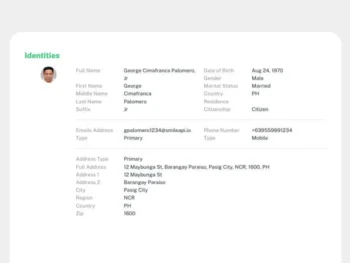
We’re excited to announce a set of enhancements and new features for our product in Q2 2022. Highlights include: More data sources, including all of the Philippines' social insurance platforms such as SSS, GSIS, Philhealth and Pag-IBIG Additional data points to the API, such as contributions Support for automatic event notifications via Webhooks Ability to invite users to share their work-related information via email Visualization of user data in the developer portal Expanded information about the data sources we have, including supported data points and attributes And many more! Check out the full release notes below for more information. More Data Sources SSS, GSIS, as well as Philhealth and Pag-IBIG* Disclaimer: All trademarks, trade names, company/product names, brands and logos appearing on this page are the property of their respective owners. Use of them is only for identification purposes and does not imply any association or affiliation with, or endorsement by the respective owners. - In this release, we're adding support for all of the Philippines' social insurance platforms which, in addition to the SSS and GSIS, now include Philhealth and Pag-IBIG. These new data sources significantly expands our coverage, and gives you an even wider range of data to work with, including employment history information and contributions. The Philhealth is the country's largest social welfare program, providing health insurance to more than 96% of the population with an estimated 32 million direct contributors. Membership is mandatory particularly for those formally employed, with contributions ranging from 2.5% in the past to, recently, as much as 4% of income, with a floor and ceiling as far as income amounts for computing the monthly contributions. Pag-IBIG, or otherwise known as the Home Development Mutual Fund, is a national savings program that is mandatory for anyone earning at least Php 1,000 a month, that has been set up to provide affordable shelter financing for Filipinos. Employees contribute 2% of their monthly income with a maximum of Php 5,000 income for computing monthly contributions. Top Employers in the Philippines* Access to production mode, using production API credentials, are required to use this feature. We have also added a list of the Top 1,000 employers in the Philippines, to allow users to find easily their employer. For those companies not in the list, users are asked to input the name of their employer manually. Afterwards we then ask them to either: Connect their social security account, so you can verify the nature of their employment Present a file upload interface, so they can upload any employment or income-related document they receive from their employer, such as tax records or payslips This employer information shows up in the API metadata or the API results, and allows for employment verification checks or comparisons with data retrieved from their work accounts or uploaded documents. Filter list of data sources in the Wink Widget - We have added additional filters to sort through the different data providers list in the Wink Widget faster, and now includes: Employers Gig Platforms Government Services HR/Payroll Systems If you want to customize the list, we have added additional parameters to the Wink Widget SDK that can be used to customize the experience when launching the widget: including filtering the particular list of
- August 16, 2022
- August 16, 2022

- August 12, 2022
- August 12, 2022
What makes a trustworthy lender? A Guide for Emerging Digital Lending Apps
Borrowing money is usually the go-to option when someone doesn’t have enough for what they need right at this moment. But, only a few people know how to do it right or are smart about it. Unfortunately, the Philippines does not have a high literacy rate on credit, or at least the formal credit channels. That could be why many Filipinos still rely more on informal sources of credit because they are not adequately informed or educated about it. Moreover, people will only try other forms of credit if the lender is trustworthy, like lending apps, which are more accessible now. With FinTech on the rise, more and more lending apps have become available and accessible. However, there is no guarantee that all online lending apps are reliable; thus, there is still a need to be wary of loan sharks. So now, the question is: how can your customers trust with money? First, you need to know what qualities your customers are looking for, and most likely, it is a safe and reliable lender worth borrowing money from. More specifically, you need to be credible enough, beneficial more than stressful, and operate legally. Credibility Consumers typically rely on user reviews and experiences to decide whether or not they will try a product. These are all over the internet; may they be posted on the company’s website or uploaded on social networking sites, like Facebook, Twitter, or Instagram. Customer reviews can make or break credibility with only one post. However, you can quickly gain new customers with positive feedback and demos. - Atome app in App Store More people will upload and share their experiences with your app when you have established credibility, which can increase your popularity. By having credibility, people unfamiliar with your product can be exposed to it by word of mouth or on social media. Features and Offers The online lending space is highly competitive and can overwhelm customers who are only starting. Promoting enticing offers and features that can benefit your users is one thing that can make them trust you. Studying your competitors and how they try to differentiate themselves from other lending apps can help make yours stand out. You also have to know what customers prefer in a lending app. Some mainstream apps have high-interest rates, so customers tend to be wary of borrowing from them, resulting in bad customer reviews or less credibility. For example, giving lower interest rates compared to other online lending apps to customers can drive customers to your product. Follows government laws and regulations What can say “trustworthy” more than being government-approved? As with any other business, you need to be registered to operate. Since the financial industry has stricter laws, money is a sensitive item to handle. There needs to be proof or certification that you are legally operating. Other online lending apps were forced to stop operating for violating laws, and the government keeps a list of verified online lending apps that are currently legal and valid through the Securities and Exchange Commission. Being on that list guarantees people they can use your app without being taken advantage of. On that note, it is important for lending apps to abide by these laws in their data collection through KYC and AML verification with the forms it makes customers fill out. Your UX with Smile With Smile API, you can have seamless data collection with better user experi
- August 12, 2022
- August 12, 2022
- July 21, 2022
- July 21, 2022
How has credit scoring changed over time?
Applying for credit is something that most would categorize under “adulting.” Since paying for credit is a huge responsibility, a person applying for a loan from a bank must be someone who can repay it and bring the proper documents they can only acquire from employers and government offices. These days, with the rise of small lending companies and accessible online loan applications, anyone can apply for a loan to borrow small amounts of money. Lending apps that use alternative data are more favorable to the new generation because it deviates from the use of traditional data, which they typically do not possess. As the number of borrowers from the new generation increases, the method for credit scoring or credit worth assessment must also adapt with it. - Image Source Credit and spending habits of millennials and gen z-ers Loans are a guaranteed way to buy what you need and want, given that you are to pay them when it’s due. Different people have varying reasons for borrowing money from banks or loan applications, and a vast observable difference can be seen in the spending habits of different generations. Here, we compare the relationship between Gen Z-ers and millennials with credit. According to Transunion, more Gen Z-ers have credit cards than millennials and are more careful about their spending habits. On the other hand, student loans were a high percentage for millennials compared to Gen Z. Most millennials are in debt of their student loans, while Gen Z-ers are more financial-conscious. Despite the threat of debt from credit or loans, the number of borrowers from newer generations are increasing, through using credit cards, online banks with loans or credit option, and BPNL (buy now, pay later) offers. - What changes were made to accommodate the new generation? The development of online banks has changed the financial landscape, especially for the new generation. Not having to travel to a bank to secure their savings is a big time-saver, knowing they have something else to do other than line up at a bank. The accessibility of online banking is a step toward financial inclusivity, and this is because there are also loan applications embedded in these systems. These features were only once available to those who have bank accounts in physical banks. Now, anyone can apply for personal and business loans through online banking and loan apps through new KYC processes that use alternative data instead of traditional physical copies. Alternative data gives everyone, not only the new generations, an opportunity to access better financial services. Smile is all for equality and inclusivity - Incorporating Smile API into your onboarding or loan processes in-app can improve efficiency in your operations. You can access identity, employment, and income data in real-time by being directly connected to government databases, gig platforms–like Grab, and HR systems, so you don’t need to process tons of paperwork. This promises more inclusive financial opportunities for all borrowers and will make credit risk assessment faster. Want to start? Book a call with us today!
- July 21, 2022
- July 21, 2022

- July 6, 2022
- July 6, 2022
Out with the old, in with the new: the effect of digitizing the KYC process
The financial world is undergoing a digital transformation. Banks and other financial institutions are increasingly adopting new technologies to streamline operations and provide customers with better services. One of the most significant changes in the digitization of Know Your Customer (KYC) processes. Know-Your-Customer or KYC is one of the essential parts of a loan application. Banks and other financial institutions are exposed to credit risk and compliance issues without proper KYC. But before there were online lending applications and platforms, loans were processed in bank branches face-to-face, using traditional KYC–collecting and verifying printed documents. What is KYC? - Image Source Know-Your-Customer (KYC) is a vital part of loan application processes where the borrowers are asked for their personal information for identity verification. Loan companies are tasked with checking their background to see if they have been involved in legal and financial issues, like violating laws and regulations within the financial industry. Background checks such as the one mentioned above show the value of KYC in a financial organization, like lending companies. It is a critical step to avoid credit risk and compliance issues. With the attempt at financial crimes globally, there are tighter regulations for BSFIs. Implementing appropriate KYC into loan applications ultimately protects financial companies from fraudulent exchanges. The challenge with traditional KYC processes In loan applications, borrowers must present printed copies of documents that loan operations specialists will verify and review. These documents will be the basis for banks and financial institutions on whether or not a borrower is qualified for a loan. However, acquiring personal data from government offices and HR departments can take days or weeks, depending on the volume of requests. On top of this, there is other bank paperwork that borrowers must answer before finally applying for a loan, asking for their personal information and confirming that the documents they submit are valid and legitimate. Depending on how many borrowers applied simultaneously, the process typically takes another few days or weeks to accomplish. Borrowers’ data are verified across the respective government offices and companies. With that said, it is evident that the overall loan application process using traditional KYC is time-consuming for both borrowers and lenders. Improve your KYC process with Smile API - With the digitalization of banks and other financial institutions comes the digitalization of loan applications. RegTech was introduced to the financial industry to address compliance and credit risk on online lending platforms, helping banks and other financial institutions with their digital KYC processes. It provides the data needed to ensure that the borrowers are not violating the Anti-Money Laundering Act. RegTech, through APIs, makes it easier for the BSFIs’ risk and compliance department to go through applications and verify the legitimacy of those documents. As the online lending space grows, many different APIs are being developed, utilizing different kinds of data–more than the traditional KYC. - Smile’s API taps into employment data sources for KYC. Connecting online banks and lending applications directly to government institutions, HR systems, and gig economy platforms can make it convenient for borr
- July 6, 2022
- July 6, 2022