

- January 27, 2023
- January 27, 2023
How access to alternative data benefits traditional banks
In today's fast-paced world, automation is becoming increasingly prevalent in every industry, and the banking sector is no exception. Automation is used to streamline processes, improve efficiency, and reduce costs. It is becoming a must-have for traditional banks to stay competitive. That’s why it pays to stay ahead of the competition and use any advantage available to make more informed decisions. One way traditional banks can do this is by leveraging digitalization and alternative data sources. - Unlocking Your Potential Through Digitalization Digitalization is no longer a nice-to-have for traditional banks, it has become a must-have. In an increasingly digitalized world, customers expect to be able to access banking services anytime, anywhere, and through multiple channels. Banks that must catch up with this digitalization trend risk losing customers to more agile fintech competitors. This is not only necessary to meet customer expectations, but it also brings significant operational benefits to banks. Automation and technology can help banks to improve efficiency, reduce costs, and make better-informed decisions. One area where traditional banks can benefit from digitalization is by using alternative data. - Exploring What Alternative Data Can Do For Traditional Banks Alternative data refers to information not typically used in traditional financial analysis, such as social media activity, online shopping habits, and mobile phone usage patterns. This data can provide valuable insights into a customer's financial behavior and creditworthiness, allowing banks to make more informed lending and investment decisions. Access to alternative data can benefit traditional banks in several ways: Improved risk management: Alternative data can be used better to assess the risk of a loan or investment, allowing banks to make more informed decisions and reduce potential losses. Increased lending opportunities: Alternative data can provide banks with a complete picture of a customer's financial situation, opening up new lending opportunities for individuals who may have yet to qualify for a loan using traditional criteria. Enhanced customer engagement: Alternative data can be used to gain a deeper understanding of customer behavior and preferences, allowing banks to create more personalized products and services that better meet their needs. Better fraud detection: Alternative data can be used to identify patterns of fraudulent activity and protect customers from financial loss. How Do You Access Alternative Data? Through Smile API! Access to alternative data can bring significant benefits to traditional banks. One solution that can enable them to access and analyze this data securely and compliantly is Smile API. Smile API provides user-authorized access to the most recent, comprehensive, and verified employment data, which can be used to make more informed lending and investment decisions. By using Smile API, traditional banks can improve risk management, increase lending opportunities, enhance customer engagement, and better detect fraud. The benefits of using Smile API for lending services include accessing and using information from customers' data sources, such as estimated incomes, liabilities, and account revoke API, to make more informed decisions. The product can also help to manage and grow loan business operations through its streamlined and automated processes. Len
- January 27, 2023
- January 27, 2023

- January 25, 2023
- January 25, 2023
Using employment history and income as a basis for making effective credit decisions
When it comes to making effective credit decisions, many lenders and financial institutions consider a client’s employment history and income level as an important factor. After all, the applicant’s ability to pay back the loan or credit is of utmost importance. By relying on a client’s employment history and income level, lenders can better assess the risk of extending a loan, and make more informed decisions on the terms and conditions of the credit. In this blog post, we will take a closer look at how to effectively use employment history and income as a basis for making credit decisions. We will discuss the importance of reviewing employment history and income, and how to properly assess the risk of extending a loan. Finally, we will provide tips on how to properly document and track credit decisions to ensure compliance with government regulations. By understanding the importance of employment history and income, credit decision makers can make more informed decisions that are in the best interests of both the borrower and the lender. 1. Understand the importance of employment history and income Understanding the importance of employment history and income when making credit decisions is an incredibly important part of the process. This is because income is a key indicator of how likely an individual is to be able to pay off their debt. It’s also important to understand the applicant’s employment history, as this can indicate how reliable the individual is in terms of making regular payments. Furthermore, understanding the applicant’s household income can help lenders understand their ability to handle financial responsibility. By looking at income, employment history, and other factors, lenders are better able to make sound credit decisions. 2. Identify the sources of income When making effective credit decisions, it is important to identify the sources of income for the loan applicant. Typically, lenders will need to review the borrower’s employment history, income from wages or salaries, and other sources of income. Employment history should provide information about the borrower’s job stability and earning potential. Income from wages or salaries should be paid regularly and can be verified through pay stubs. Other sources of income such as bonuses, commissions, investments, or rental properties should also be taken into account. Collecting this information up front will help lenders make a more informed decision when assessing the creditworthiness of a loan applicant. 3. Analyze the borrower’s ability to pay Once a borrower’s employment and income have been verified, the next step is to analyze their ability to pay. This step is crucial in making an effective credit decision. The lender must be confident that the borrower will be capable of meeting their financial commitments. This can be determined by analyzing their income, debts, and other obligations. The lender should assess the borrower’s income to debt ratio, as well as the amount of their monthly income that is dedicated to debt repayment. If the amount is too high, the lender may choose not to extend the credit. It is important to note that borrowers with a steady income may still be unable to make timely payments if their expenses are greater than their income. 4. Evaluate the creditworthiness of the borrower Evaluating the creditworthiness of a borrower is one of the most important steps when consideri
- January 25, 2023
- January 25, 2023

- January 20, 2023
- January 20, 2023
Smile API Joins Provenir Marketplace to Enhance Credit Decision Making
Singapore, January 17, 2023 - Smile Technology Pte Ltd, a leading provider of employment and income data in Asia, announced today that it has joined the Provenir Marketplace. The Provenir Data Marketplace is a one-stop hub that offers businesses worldwide easy access to various data sources for various needs, such as KYC, fraud, credit risk, identity verification, and more. Smile API provides customers easy access to a wide range of employment information from various sources through a single API. This information can be used for credit decisions and loan underwriting, which can help reduce nonperforming loans. Through this partnership, Provenir users will now have access to Smile API's valuable employment and income data. Smile API's data is sourced from HR, payroll, commerce, and marketplace platforms, and is fully compliant with local data privacy regulations. Unlike traditional credit data sources, Smile API provides greater coverage, real-time access, and the most recent, comprehensive, verified data about a user's identity, employment, and income. By integrating Smile API's technology, businesses will have a more robust and detailed picture of a person's creditworthiness, allowing them to make more informed and accurate credit decisions. "We are excited to be joining the Provenir Marketplace," said Jerome Eger, CEO of Smile Technology. "This partnership will allow us to expand our reach and provide our data to a wider range of financial services and fintech companies in the region." About Smile API Smile Technology Pte Ltd is one trusted source for employment data in Asia. Smile provides user-authorized access to valuable employment and income data from HR, payroll, commerce, and marketplace platforms through a single API. Banks, fintechs, recruitment agencies, and other service providers can leverage employment and income data to increase adoption and conversion and reduce cost and risk. Permission to access their personal data is given by each user to enable seamless data sharing with trusted parties. About Provenir Provenir offers a platform that utilizes AI to assist financial service providers in making faster and more informed decisions. The platform combines data, AI, and decision-making tools into one solution to enhance the customer experience, increase access to financial services, and improve overall business agility for organizations. Provenir’s platform is utilized by financial service providers in over 50 countries and processes billions of transactions annually.
- January 20, 2023
- January 20, 2023

- December 28, 2022
- December 28, 2022
Exploring the Latest Trends in Lending
Lending is an ever-evolving industry, and there are many different trends that are shaping the way lending is done today. Some of the key trends in lending include: The rise of online and digital lending platforms, which are making it easier and more convenient for borrowers to access credit. The rise of online and digital lending platforms is revolutionizing the way that borrowers access credit. These platforms are making it easier and more convenient for borrowers to access credit by eliminating paperwork and reducing processing times. As a result, borrowers can receive the money they need faster than ever before. Additionally, online and digital lending platforms also provide greater transparency for borrowers, ensuring that they understand the terms of the loan before signing any documents. These platforms are also creating more competition in the lending space, driving down interest rates and increasing the availability of credit. Ultimately, the rise of online and digital lending platforms is making it easier and more convenient for borrowers to access the credit they need. The growth of peer-to-peer (P2P) lending, which allows individuals to lend and borrow money directly without the need for a traditional financial institution. Peer-to-peer (P2P) lending has grown rapidly in recent years, giving individuals the ability to lend and borrow money directly, without the need for a traditional financial institution. P2P lending typically involves providing funds to a borrower, who then pays the lender back with additional interest. This has the potential to provide an alternative form of credit to those who might not have access to traditional financial services. Additionally, lenders are able to generate income through the interest they earn on the loans, while borrowers gain access to funds without the high interest rates commonly associated with traditional forms of credit. P2P lending platforms have also contributed to greater financial inclusion, providing access to loan opportunities to a much wider range of borrowers. As the P2P lending market continues to grow, it has the potential to revolutionize the way individuals access credit. The increasing use of alternative data sources to assess creditworthiness and make lending decisions, such as information from social media and other online platforms. The increased use of alternative data sources to assess creditworthiness and make lending decisions is rapidly becoming a popular industry trend. Alternative sources such as social media and other online platforms can provide a more comprehensive assessment of a customer's creditworthiness and financial stability. These sources offer more detailed insights into a customer's current financial situation, allowing lenders to make more informed decisions. Additionally, lenders can use this data to assess risk and identify potential fraud patterns. As technology advances, alternative data sources will continue to become an integral part of the loan process. It is essential for lenders to ensure that the data used is reliable, accurate, and compliant with all relevant regulations. This will help ensure that customers receive the best service possible and that lenders are making responsible lending decisions. The expansion of microlending and other forms of small-scale lending, which are helping to bring financial services to underserved populations. The expansion of microlen
- December 28, 2022
- December 28, 2022
- December 28, 2022
- December 28, 2022
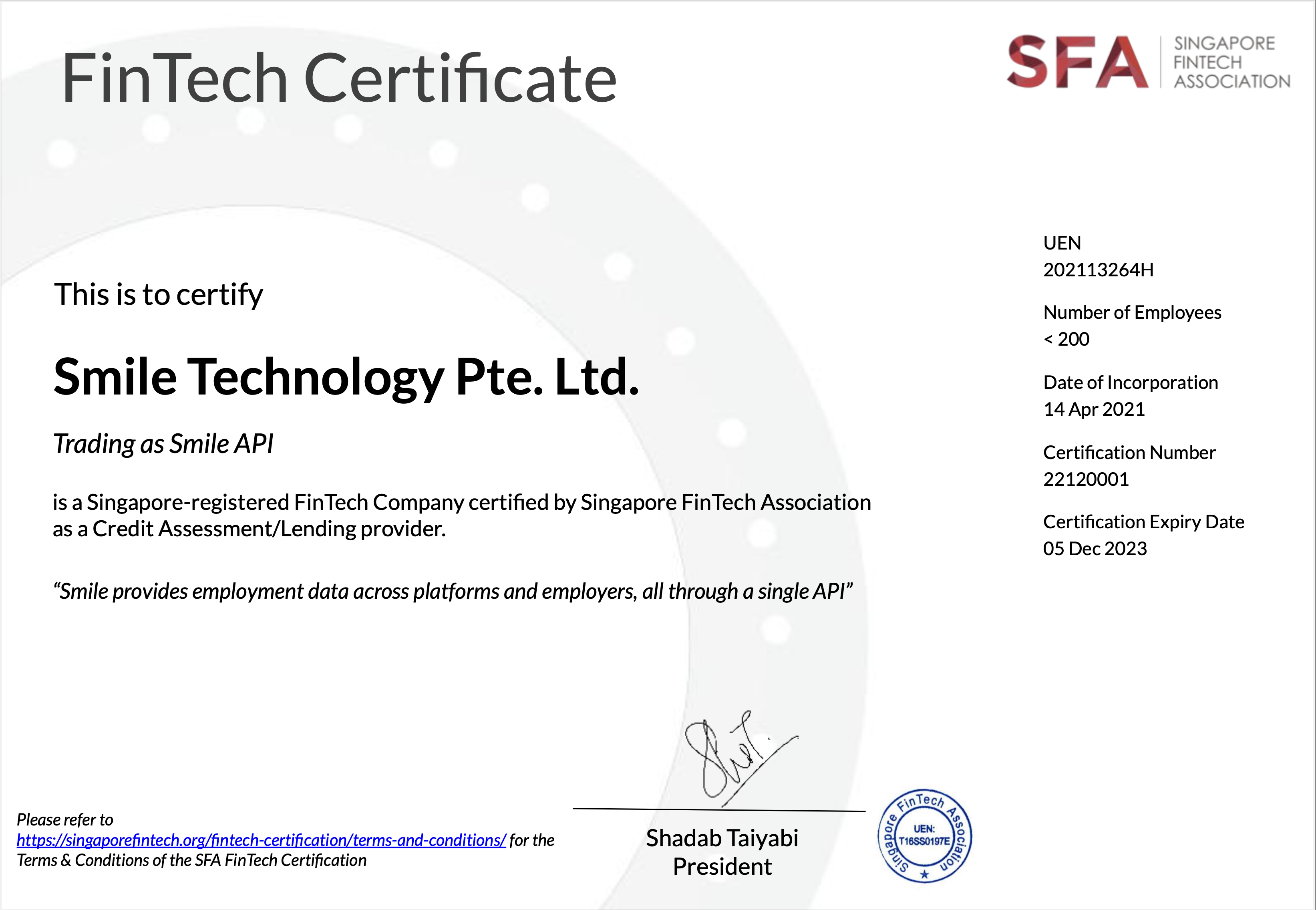
Smile is Recognized as a Certified FinTech by the Singapore FinTech Association
Singapore, December 27, 2022 - Smile API, the leading provider of innovative financial technology solutions, is proud to announce that it has been certified as a FinTech by the Singapore FinTech Association (SFA). The SFA's FinTech certification program distinguishes the FinTech companies from other SFA members and FinTechs in the marketplace by assessing the company's capabilities and products in the areas of financial services solutions, customer experience, and the use of technology. It is awarded to companies that provide technology solutions to improve and automate the delivery of financial services to end customers, businesses or as a partner to financial institutions, as well as those that enable innovative products and services. The certification is designed to help FinTechs stand out in a competitive landscape, providing assurance to stakeholders that they have met a set of standards that are recognized by the Monetary Authority of Singapore (MAS) to avail of various grants offered by MAS and similar government entities in the city-state. Smile API provides employment data across different employment platforms and employers, all through a single API for credit decisions and loan underwriting. Unlike traditional sources of credit data like credit scores, black lists or manually submitted documents, we provide greater coverage, real-time access, and the most recent, comprehensive, verified, data about your users' identity, employment and income that is available in the market today. "We are honored to receive this certification from the SFA," said Jerome Eger, CEO of Smile API. "This recognition is a testament to the hard work and dedication of our team, who are constantly striving to deliver the best possible financial technology solutions to our customers. Smile API is also excited to be part of the SFA community and to be recognized as a Certified FinTech. This will further our goal of bringing Financial inclusion in the region, by making it easier for companies based in Singapore to use Smile API and take advantage of government incentives and grants. We are working hard to make financial inclusion a reality by ensuring that everyone has access to the financial tools and resources they need to improve their lives. When people are financially included, they can build savings, access credit, and make investments that can help them escape poverty and build a better future for themselves and their families. One of the biggest barriers to financial inclusion has been because financial services have been costly to bring and offer to the lowest economic segments of society because of a lack of reliable data. However, with Smile this can change.” About Smile API Smile Technology Pte Ltd is the one trusted source for employment data in Asia. Smile provides user-authorized access to valuable employment and income data from HR, payroll, commerce, and marketplace platforms through a single API. Banks, fintechs, recruitment agencies, and other service providers can leverage employment and income data to increase adoption and conversion, reduce cost, and reduce risk. Permission to access their own personal data is given by each individual users themselves, so they can seamlessly share this data with the parties they trust. https://www.getsmileapi.com/ About Singapore FinTech Association The SFA is a cross-industry and non-profit organisation. Its purpose is to support the
- December 28, 2022
- December 28, 2022

- December 21, 2022
- December 21, 2022
How to use Smile API to expand your lending services
Why you should get started with expanding your lending services Philippine banks are upbeat on loan demand for the current quarter as post-pandemic optimism takes hold. Based on recent survey results, the BSP saw an uptick in demand for all household loans, including mortgages, credit card lines of credit, auto loans, and personal income financing. Consumers feel more secure about taking out these necessary forms of borrowing as conditions in domestic and global markets continue to improve. Filipinos receiving a loan have increased significantly from 29% in 2017 to 41% in 2019. This data is not surprising since more Filipinos recognize the need to manage their finances and learn more about the financial services accessible to them. Common reasons Filipinos apply for a loan; they are underbanked for educational purposes, medical expenses, setting up a business or investment, home and auto improvements, and debt consolidation. Thankfully there are helpful processes that increase operational efficiency and maximize profits as well as faster turnaround times and are more reliable and consistent in their results. - Image Source Automated and streamlined processes Automation and streamlining business processes are essential to increasing operational efficiency and maximizing profits. Automating manual tasks means less time is spent on administrative duties, increasing the amount of time available for productive activities. Streamlining processes removes redundancies and helps ensure business operations' smooth operation, yielding maximum output with minimum effort. Automated functions allow for much faster turnaround times, are more reliable and consistent in their results, increase transparency, and create a much higher level of customer service satisfaction. Implementing automated and streamlined processes can tremendously impact profit margins and productivity levels. - Image Source What is an automated loan processing? An automated loan processing system is a software-based solution that uses cutting-edge cloud and online technologies to digitize and automate all stages of the loan cycle. Unlike its predecessor, the automated loan processing system allows for faster processing and eliminates the need for documentation or face-to-face communication. Automated loan management systems are revolutionizing the way loans are managed. By streamlining processes and improving decision-making accuracy, these revolutionary systems help to increase efficiency and enhance security features, all while providing a 24/7 online assistance system for ultimate convenience. It's no wonder they're quickly becoming integral to the current loan administration! Advantages of Using Automation and Streamlined Processes Lending companies receive an incredible number of loan applications each week, yet only a fraction meet their lending criteria. By utilizing automated processing, banks and other lenders can quickly evaluate which applicants best fit these procedures- allowing them to make quick contact with those who qualify before underwriting loans in confidence. This system enables lenders to: Improve the speed and accuracy of loan applications to provide a better user experience. Increase the number of loan applications processed with existing resources. Reduce human error while making faster, higher-quality evaluation judgments. Create predictable, repeatable, and auditable processes to supp
- December 21, 2022
- December 21, 2022