

- September 7, 2022
- September 7, 2022
Smile API to debut Fintech podcast on September 9 addressing credit scoring challenges
- Smile API will launch its pilot Fintech podcast on September 9 addressing the challenges in credit scoring that burden banks and other financial institutions. Led by Smile CEO Jerome Eger, the debut episode will stream at 5 PM on YouTube, Spotify, Facebook, and LinkedIn participated in by Aian Guanzon, the business head of Global Dominion Financing, Inc. (GDFI). The Smile API Podcast shall be a series of episodes that will feature experts and talents in fintech, banking, and credit risk management providing perspectives on digital banking, the open finance era, alternative data, and much more! In the pilot episode, viewers will have the opportunity to learn about effective credit scoring solutions. They are designed to help lenders make the right lending decisions by having not only reliable but more importantly relevant information on loan applicants and potential customers. For many lending companies, credit scoring could be tedious especially if done through traditional sources of credit data like credit scores, black lists, or manually submitted documents. Thankfully today, advancements in information infrastructure have made it possible to make credit risk assessment faster and with more meaning and value through access to alternative data. They involve a wide variety of information like identity, employment, income data, and government transactions to name a few. Other topics included in the pilot episode are KYC or Know Your Customer processes, dependence on digital mobile and online payments, open finance framework in the Philippines, as well as a beneficial use of income data. About Smile Smile believes that access to your own data is a basic right. They provide employment data across different employment platforms and employers, all through a single API for credit decisions and loan underwriting. Unlike traditional sources of credit data like credit scores, black lists, or manually submitted documents, Smile provides greater coverage, real-time access, and the most recent, comprehensive, verified, data about your users' identity, employment, and income that is available in the market today. Lenders can make better decisions, increase adoption and conversion, reduce cost, and lower risk through Smile API. About GDFI “We are a financial institution helping Filipinos achieve their goals through easy and affordable loan products and services. We have been championing innovative loan facilities to cater to the changing needs of our customers, whether for car purchases, business capital, tuition fee, home improvement, or even emergency and medical expenses, with easily manageable interest rates and convenient payment options. For more than a decade we have been the leading financial services provider to various sectors including OFWs, professionals, business owners, and executives, offering tailor-fit cash loans and financial services. With more than 78 branches nationwide, we are highly equipped to serve you, wherever you are.” About Jerome Eger Jerome Eger is the CEO of Smile API which was launched in May 2020. Their team aims to cover all of Asia by giving workers greater access to financial services by facilitating the easy sharing of their employment and income data. About Aian Guanzon Aian Guanzon is a nurse with a bachelor in nursing (BSN) degree from the Our Lady of Fatima University (OLFU), the current head of business development in Glob
- September 7, 2022
- September 7, 2022

- August 31, 2022
- August 31, 2022
Investing in the Future of Finance: What Smile Contributes and Will Contribute to the FinTech Industry
In recent times, Financial Technology or FinTech has become well-known for its fast-paced innovations in FinTech markets: Financing, Asset Management, and Payments. As the worldwide FinTech market is expected to reach $16,652.68 billion by 2028, it is crucial to stay abreast of the most recent financial service delivery techniques. Following this, it is essential for lending institutions to consistently adopt new approaches and gradually migrate from traditional to alternative data. Smile API utilizes this strategy for lending institutions and provides an API that enables borrowers to communicate employment and income information with lenders effortlessly. Lending institutions will no longer have to undergo lengthy onboarding procedures. - The Data Headache for the Lending Industry The lending industry comprises central banks, retail and commercial banks, internet banks, credit unions, savings, and loans associations, investment banks, investment companies, brokerage firms, insurance companies, and mortgage companies. Most of these companies follow traditional credit scoring, which involves acquiring employment data and proof of employment on their own. Typically, they do not have real-time access to this data which is often inaccurate and difficult to verify. - With alternative credit scoring, however, lending institutions can get better coverage, real-time access, and the most up-to-date, comprehensive, and reliable information on borrowers' identities, jobs, and income via alternative credit scoring. To determine if a borrower qualifies for a loan, these institutions don't have to waste precious time calling financial institutions like SSS, GSIS, Philhealth, Pag-IBIG, and the borrower's employers. How Smile Can Help Smile operates specifically as an invisible bridge between borrowers and lenders. It offers an API that makes it easier for borrowers to supply relevant information when requesting loan approvals, as traditional credit scoring may be difficult for lenders. Thus, the onboarding process is more efficient and reliable. More precisely, when a borrower submits an online application for loan approval, they must include basic information like their full name, address, gender, contact information, civil status, and employment status. Smile's single API coverage comprises data from the social insurance platforms listed. Given all those processes, it could be tedious and even take weeks to verify thoroughly– and is prone to data inaccuracies. But with Smile, this is all done simply, securely, and seamlessly! Smile's single API will do everything in real-time and with the end user's consent. How Safe Is Smile? Now that you know what the Smile API does, you might wonder about the safety of using it and how secure it is for lenders and borrowers. There’s no need to worry! - Since the data is encrypted while it is being transferred and the only connection is between the user and the lender, the information is safe and strictly confidential. More specifically, Smile's API employs a strong authentication%20is%20encrypted%20and%20unmodified.) that all data will only be shared once the end-user authorizes it to guarantee the safety and security of all data. Smile and the FinTech Industry Smile API made a firm commitment two years ago to contribute significantly to the FinTech industry by creating trust and ensuring security for all of its clients and potential clients.
- August 31, 2022
- August 31, 2022
- August 16, 2022
- August 16, 2022
Product Update: Q2 2022
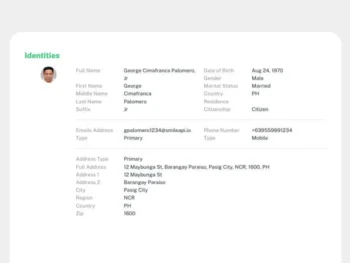
We’re excited to announce a set of enhancements and new features for our product in Q2 2022. Highlights include: More data sources, including all of the Philippines' social insurance platforms such as SSS, GSIS, Philhealth and Pag-IBIG Additional data points to the API, such as contributions Support for automatic event notifications via Webhooks Ability to invite users to share their work-related information via email Visualization of user data in the developer portal Expanded information about the data sources we have, including supported data points and attributes And many more! Check out the full release notes below for more information. More Data Sources SSS, GSIS, as well as Philhealth and Pag-IBIG* Disclaimer: All trademarks, trade names, company/product names, brands and logos appearing on this page are the property of their respective owners. Use of them is only for identification purposes and does not imply any association or affiliation with, or endorsement by the respective owners. - In this release, we're adding support for all of the Philippines' social insurance platforms which, in addition to the SSS and GSIS, now include Philhealth and Pag-IBIG. These new data sources significantly expands our coverage, and gives you an even wider range of data to work with, including employment history information and contributions. The Philhealth is the country's largest social welfare program, providing health insurance to more than 96% of the population with an estimated 32 million direct contributors. Membership is mandatory particularly for those formally employed, with contributions ranging from 2.5% in the past to, recently, as much as 4% of income, with a floor and ceiling as far as income amounts for computing the monthly contributions. Pag-IBIG, or otherwise known as the Home Development Mutual Fund, is a national savings program that is mandatory for anyone earning at least Php 1,000 a month, that has been set up to provide affordable shelter financing for Filipinos. Employees contribute 2% of their monthly income with a maximum of Php 5,000 income for computing monthly contributions. Top Employers in the Philippines* Access to production mode, using production API credentials, are required to use this feature. We have also added a list of the Top 1,000 employers in the Philippines, to allow users to find easily their employer. For those companies not in the list, users are asked to input the name of their employer manually. Afterwards we then ask them to either: Connect their social security account, so you can verify the nature of their employment Present a file upload interface, so they can upload any employment or income-related document they receive from their employer, such as tax records or payslips This employer information shows up in the API metadata or the API results, and allows for employment verification checks or comparisons with data retrieved from their work accounts or uploaded documents. Filter list of data sources in the Wink Widget - We have added additional filters to sort through the different data providers list in the Wink Widget faster, and now includes: Employers Gig Platforms Government Services HR/Payroll Systems If you want to customize the list, we have added additional parameters to the Wink Widget SDK that can be used to customize the experience when launching the widget: including filtering the particular list of
- August 16, 2022
- August 16, 2022

- August 12, 2022
- August 12, 2022
What makes a trustworthy lender? A Guide for Emerging Digital Lending Apps
Borrowing money is usually the go-to option when someone doesn’t have enough for what they need right at this moment. But, only a few people know how to do it right or are smart about it. Unfortunately, the Philippines does not have a high literacy rate on credit, or at least the formal credit channels. That could be why many Filipinos still rely more on informal sources of credit because they are not adequately informed or educated about it. Moreover, people will only try other forms of credit if the lender is trustworthy, like lending apps, which are more accessible now. With FinTech on the rise, more and more lending apps have become available and accessible. However, there is no guarantee that all online lending apps are reliable; thus, there is still a need to be wary of loan sharks. So now, the question is: how can your customers trust with money? First, you need to know what qualities your customers are looking for, and most likely, it is a safe and reliable lender worth borrowing money from. More specifically, you need to be credible enough, beneficial more than stressful, and operate legally. Credibility Consumers typically rely on user reviews and experiences to decide whether or not they will try a product. These are all over the internet; may they be posted on the company’s website or uploaded on social networking sites, like Facebook, Twitter, or Instagram. Customer reviews can make or break credibility with only one post. However, you can quickly gain new customers with positive feedback and demos. - Atome app in App Store More people will upload and share their experiences with your app when you have established credibility, which can increase your popularity. By having credibility, people unfamiliar with your product can be exposed to it by word of mouth or on social media. Features and Offers The online lending space is highly competitive and can overwhelm customers who are only starting. Promoting enticing offers and features that can benefit your users is one thing that can make them trust you. Studying your competitors and how they try to differentiate themselves from other lending apps can help make yours stand out. You also have to know what customers prefer in a lending app. Some mainstream apps have high-interest rates, so customers tend to be wary of borrowing from them, resulting in bad customer reviews or less credibility. For example, giving lower interest rates compared to other online lending apps to customers can drive customers to your product. Follows government laws and regulations What can say “trustworthy” more than being government-approved? As with any other business, you need to be registered to operate. Since the financial industry has stricter laws, money is a sensitive item to handle. There needs to be proof or certification that you are legally operating. Other online lending apps were forced to stop operating for violating laws, and the government keeps a list of verified online lending apps that are currently legal and valid through the Securities and Exchange Commission. Being on that list guarantees people they can use your app without being taken advantage of. On that note, it is important for lending apps to abide by these laws in their data collection through KYC and AML verification with the forms it makes customers fill out. Your UX with Smile With Smile API, you can have seamless data collection with better user experi
- August 12, 2022
- August 12, 2022
- July 21, 2022
- July 21, 2022
How has credit scoring changed over time?
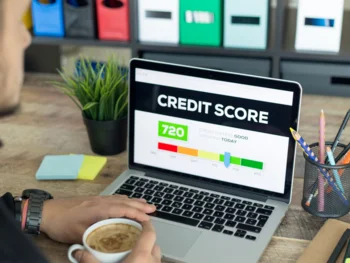
Applying for credit is something that most would categorize under “adulting.” Since paying for credit is a huge responsibility, a person applying for a loan from a bank must be someone who can repay it and bring the proper documents they can only acquire from employers and government offices. These days, with the rise of small lending companies and accessible online loan applications, anyone can apply for a loan to borrow small amounts of money. Lending apps that use alternative data are more favorable to the new generation because it deviates from the use of traditional data, which they typically do not possess. As the number of borrowers from the new generation increases, the method for credit scoring or credit worth assessment must also adapt with it. - Image Source Credit and spending habits of millennials and gen z-ers Loans are a guaranteed way to buy what you need and want, given that you are to pay them when it’s due. Different people have varying reasons for borrowing money from banks or loan applications, and a vast observable difference can be seen in the spending habits of different generations. Here, we compare the relationship between Gen Z-ers and millennials with credit. According to Transunion, more Gen Z-ers have credit cards than millennials and are more careful about their spending habits. On the other hand, student loans were a high percentage for millennials compared to Gen Z. Most millennials are in debt of their student loans, while Gen Z-ers are more financial-conscious. Despite the threat of debt from credit or loans, the number of borrowers from newer generations are increasing, through using credit cards, online banks with loans or credit option, and BPNL (buy now, pay later) offers. - What changes were made to accommodate the new generation? The development of online banks has changed the financial landscape, especially for the new generation. Not having to travel to a bank to secure their savings is a big time-saver, knowing they have something else to do other than line up at a bank. The accessibility of online banking is a step toward financial inclusivity, and this is because there are also loan applications embedded in these systems. These features were only once available to those who have bank accounts in physical banks. Now, anyone can apply for personal and business loans through online banking and loan apps through new KYC processes that use alternative data instead of traditional physical copies. Alternative data gives everyone, not only the new generations, an opportunity to access better financial services. Smile is all for equality and inclusivity - Incorporating Smile API into your onboarding or loan processes in-app can improve efficiency in your operations. You can access identity, employment, and income data in real-time by being directly connected to government databases, gig platforms–like Grab, and HR systems, so you don’t need to process tons of paperwork. This promises more inclusive financial opportunities for all borrowers and will make credit risk assessment faster. Want to start? Book a call with us today!
- July 21, 2022
- July 21, 2022
- July 15, 2022
- July 15, 2022
Smile launches work-income data survey giving away prizes, supporting donations to PWDs
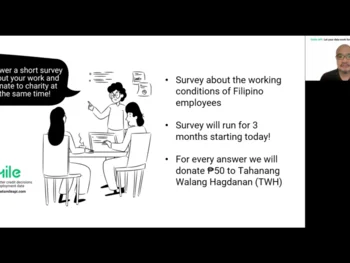
- MANILA, Philippines (July 18, 2022) -- We are inviting you workers to participate in our work and income data survey and get the chance to win Lazada gift cards as well as the opportunity to donate to the Tahanang Walang Hagdanan, Inc (TWHI), a non-stock, non-profit organization that provides programs and services to Filipinos with orthopedic disabilities. For every completely answered survey we will be donating ₱50 to TWHI. Share this survey https://zcu.io/zoJP to your colleagues, then register to join the raffle where we will give away Lazada Gift Cards worth ₱1,000. You can even increase your chances of winning by referring as many coworkers as you can. The survey is available on various online platforms which will run until September 30, 2022. The short survey is part of Smile API's efforts in creating a win-win situation between workers, financial institutions and other businesses when it comes to availing of financial services and products, making better credit decisions, including but not limited to improving recruitment and hiring processes. We chose to partner with TWHI since their mission of inclusion intersects with Smile's own values and that is helping people, especially those in underserved communities to gain access to better opportunities. Founded in 1973 by a Belgian nun, Sr. Valeriana Baerts, ICM, the TWHI center works to uplift the lives of persons with orthopedic impairment – by helping them become self-sufficient and contributing members of the society. According to TWHI Administrative Manager Ramon Apilado, their center runs a number of workshops employing PWDs for the production of wheelchairs, furniture, bags, and many other goods, including the tertiary packaging of medicines from partner pharmaceutical companies. "We may be persons with disabilities but we can do jobs other people can't do, you just have to give us the opportunity and we can do the job well," Apilado said. "We are thankful to Smile API for choosing our organization TWH to be one of their partners, and we are very happy because for very completed survey, 50 pesos will be donated to our organization." About Us Smile Technology Pte Ltd is one trusted source for employment data in Asia. Smile provides user-authorized access to valuable employment and income data from HR, payroll, commerce, and marketplace platforms through a single API. Banks, fintechs, recruitment agencies, and other service providers can leverage employment and income data to increase adoption and conversion, reduce cost, and risk. Permission to access their own personal data is given by each individual user, to enable seamless data sharing with trusted parties. https://www.getsmileapi.com
- July 15, 2022
- July 15, 2022