
- May 9, 2026
- May 9, 2026
Boost Conversion Rates: Wink Widget Fixes 40% Income Verification Drop-Off
Did you know that nearly 40% of users drop off during manual income verification?Asking a user to leave your app, find a PDF payslip, and upload a blurry screenshot is a recipe for abandonment. To keep your users engaged, you need a verification flow that feels like a feature, not a chore.The Friction of Manual VerificationManual verification is slow, prone to fraud, and—most importantly—frustrating for the user.When a user hits a "Upload Document" wall, the momentum of your onboarding process grinds to a halt. This is where most fintech apps lose their hard-earned leads.Enter the Wink Widget: Consent-Driven SimplicityThe Wink Widget is designed to bridge the gap between security and user experience.By providing a professional, transparent interface, it guides users through "Consent-Driven Data Sharing." Users feel in control because they are explicitly granting access to their data in a secure environment.Key Benefits of the Wink Widget:Instant Trust: A clean, branded UI that looks and feels secure.No More PDFs: Data is pulled directly from the source, eliminating manual uploads.Higher Completion Rates: A seamless 30-second flow replaces a 3-day manual process.Building Trust Through TransparencyTransparency is the ultimate conversion tool.The Wink Widget clearly outlines what data is being accessed and why, which is a core tenet of modern data privacy standards. When users trust the process, they complete the journey.Don't let clunky verification processes kill your growth. By implementing the Wink Widget, you provide a frictionless experience that respects your user's time and builds the trust necessary for a long-term relationship.Stop the drop-off today. See the Wink Widget in action at https://portal.getsmileapi.com/
- May 9, 2026
- May 9, 2026
- May 8, 2026
- May 8, 2026
Why Your Backend Needs a Strategic Data Partner to Scale
- Stop building individual integrations for every platform. Your engineering team’s time is your most valuable currency. If you are still building custom scrapers for every gig platform or payroll provider, you are spending currency you can't afford to lose. Here's why your backend needs a strategic data partner to scale.The "Old Way": The Integration Debt TrapBuilding a custom connection for Upwork, then another for Grab, and another for a local payroll system creates a "spaghetti code" backend.Every time one of those platforms updates its UI or API, your integration breaks. This leads to endless maintenance hours and a backend that is fragile rather than agile. - The "Smile API Way": One Connection, Infinite PossibilitiesA data partner like Smile API acts as a universal translator for employment data.Instead of dozens of fragile links, your backend maintains one robust connection to the Smile API platform. We handle the maintenance, the provider updates, and the data normalization so you don't have to.Why Developers Prefer the Smile API WayReduced Maintenance: We manage the "breaking changes" from providers.Faster Time-to-Market: Launch in new regions by simply toggling on new providers.Clean Data: Receive standardized JSON regardless of the original source.Your backend should be a powerhouse for your core product, not a graveyard of custom scrapers. By choosing a data partner, you reclaim your engineering team's focus and build a foundation that is ready for global scale.Ready to simplify your architecture? Learn more about our unified API at www.getsmileapi.com
- May 8, 2026
- May 8, 2026
- February 12, 2026
- February 12, 2026
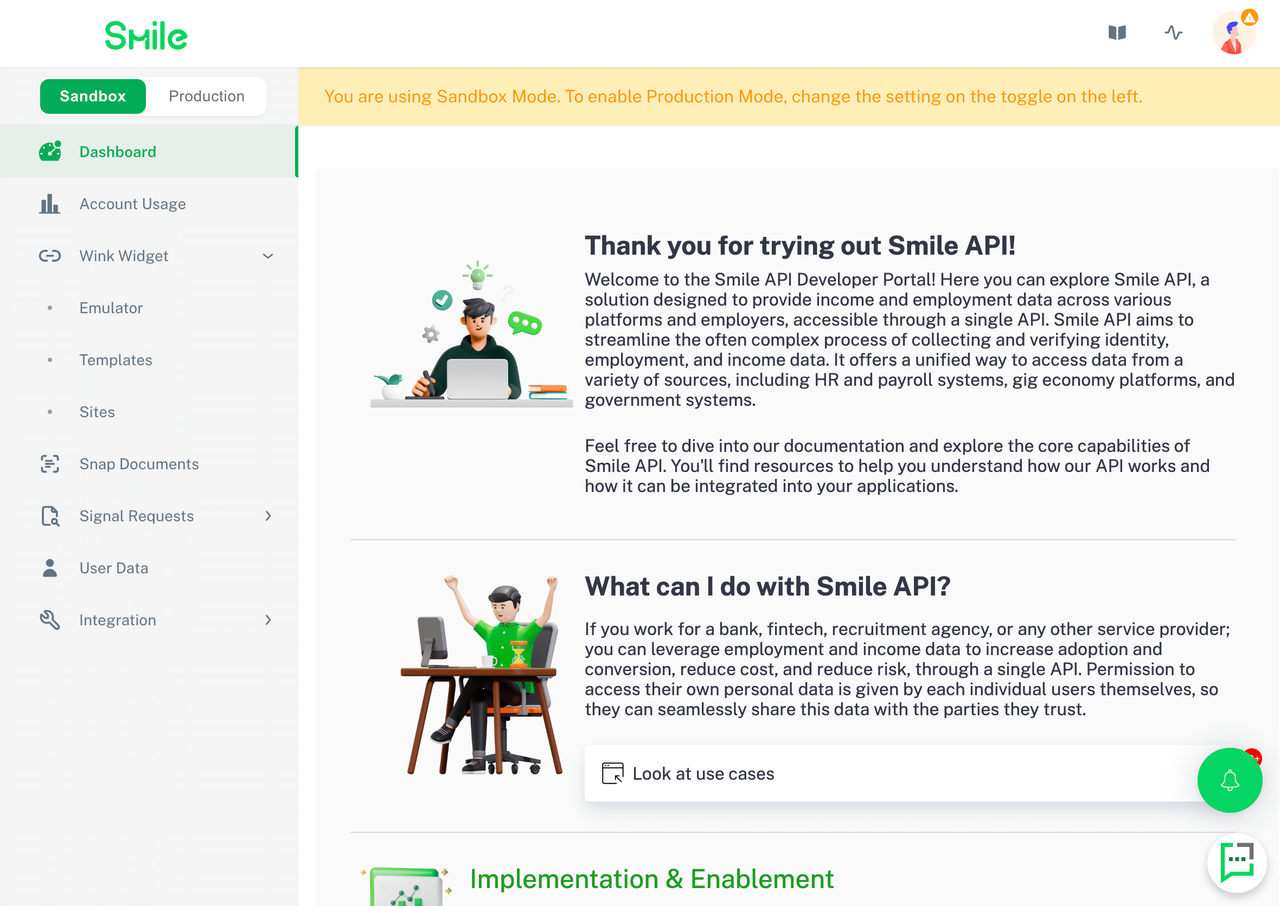
Smile API Product Updates: Smarter Risk & Faster Builds
Smile API product updates in 2025 focused on smarter risk signals, higher-converting user journeys, and faster, more predictable integrations for fintech teams across the Philippines. From the launch of the highly customisable Wink Site V3 to significant expansions in our Signals risk suite and document processing capabilities, every update was designed to help you build more secure and seamless user journeys.We focused on three themes that matter most to fintechs, lending businesses, and banks in the Philippines: stronger risk signals, higher-conversion user journeys, and faster, more predictable integrations for developers.Rather than shipping isolated features, we invested in cohesive improvements across our Signals suite, Wink experiences, data coverage, and Developer Portal—helping teams move from experimentation to production with confidence.Below is a recap of the most meaningful product updates from the past year.Wink Site V3: Orchestrating Custom User JourneysThe release of Wink Site Version 3 shifted our platform from a static widget to a fully customisable user journey builder. This evolution allows for greater control over how data is collected and presented to end users.Customisable Journeys: Builders can now create multi-screen pages with a powerful routing feature that directs users based on their inputs.Enhanced Data Quality: New Input Validation rules for phone numbers, emails, and URLs ensure that the data collected is accurate and formatted correctly before submission.Dynamic Personalisation: Support for Form Field Variables and URL parameters allows you to prefill fields or display previous responses later in the flow for a personalised experience.Mobile-First Design: The site is now fully responsive, ensuring an optimal experience across mobile, tablet, and desktop devices.Built-in Content Tools: New Paragraph and Markdown components allow for the inclusion of helpful text, bulleted lists, and company logos directly within the journey. - Why this mattersIncrease completion rates by setting clear expectations for usersBuild trust through localized language and transparent data useReduce drop-offs with better guidance and progress visibilityMatch your brand experience without heavy front-end workStay compliant while improving user confidence in data sharingWink Widget: Refining the End-User ExperienceWe implemented several updates to the Wink Widget to improve loading speeds, clarity, and accessibility for a global audience.Visual Transparency: We expanded data transparency messaging platform-wide after seeing it improve conversion rates by clearly explaining what data is being accessed.Optimised Loading: By using cached data sources and minimising the widget's footprint, we significantly improved loading performance and reduced drop-offs.Simplified Navigation: Provider categories were consolidated into straightforward groups like Government Service and Gig Platforms, helping users find their data sources faster.Contextual Guidance: Added micro-interactions and contextual help text to login screens to guide users through authentication more smoothly.Improved Accessibility: We launched language localisation A/B tests in the Philippines, supporting Tagalog, Bisaya, Ilonggo, and Ilocano to make onboarding clearer for more users. While the minimal conversion uplift saw us revert these changes, Smile remains ready to launch this feature for special use cases.
- February 12, 2026
- February 12, 2026
- February 10, 2026
- February 10, 2026
About Agentic AI: What You Need to Know as a Bank or Lender
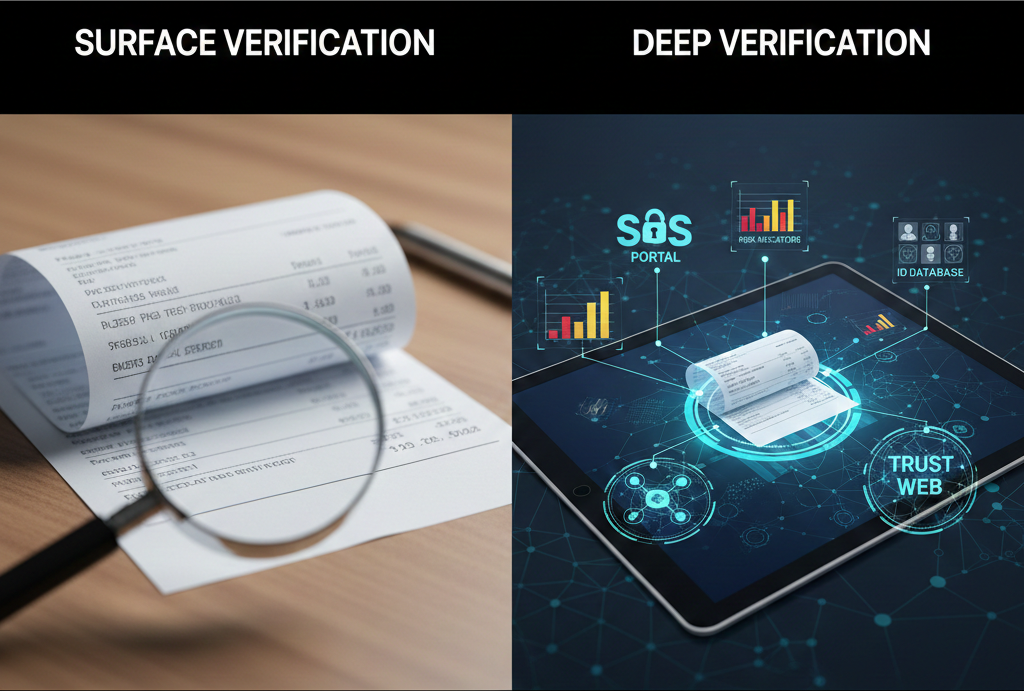
A loan officer at a consumer finance company in Manila reviews an application from a call center agent. Monthly income: ₱35,000. The applicant uploads a payslip PDF. An AI agent processes it automatically. Payslip verified. Income extracted. Loan approved in eight hours. Three months later, the loan defaults. The payslip was real—but it was from a side job the applicant worked for two months before applying. Her primary income? Half of what she claimed. The AI agent never cross-checked the payslip income against her SSS contribution history, which would have shown the discrepancy immediately. Here's the thing: you're not actually afraid of AI making decisions. You're afraid of AI making decisions based on data it never verified deeply enough in the first place. And as AI shifts from tool to agent—from something you ask to something that acts on your behalf—the question becomes: How do we give AI agents a trust baseline strong enough that they're not approving loans based on documents that look real but tell incomplete stories? I'm going to share what agentic AI actually is, why the trust problem in the Philippines (and markets like it) isn't about continuous monitoring—it's about verification depth at origination—and the infrastructure layer that makes AI decisioning defensible. What Agentic AI Actually Means (And Why Verification Depth Matters More Than Speed) Let's clear up the terminology first, because "agentic AI" sounds like something out of a tech keynote, not your lending operations in Quezon City. Here's the distinction that matters: AI as a tool: You ask it a question, it gives you an answer. You review a loan application, you ask the AI to extract data from a payslip, it returns the income figure. You're still deciding whether to approve. AI as an agent: It acts on your behalf. It extracts income from the payslip, cross-references it with government contribution records, checks for overleveraging signals across other lenders, verifies the borrower's identity through face matching, flags any blacklist warnings, and auto-approves or rejects the application—before a human loan officer ever sees it. The shift is from "Can we trust the AI's output?" to "Can we trust that the AI verified the inputs deeply enough before making the decision?" You're already seeing this in Philippine financial services: AI agents processing loan applications end-to-end for BPO employees, retail workers, and salaried staff AI agents auto-approving or rejecting based on extracted document data, risk scores, and identity verification AI agents flagging fraud patterns—multiple loan applications, blacklist matches, income-contribution mismatches The technology is deployed. The question is whether the verification depth underneath the AI is sufficient—or whether you're approving loans based on surface-level document checks that miss the fraud hiding in plain sight. Let me show you what happens when verification depth is too shallow. Before/After: The Overleveraging Blind Spot Before: A digital lender in Metro Manila used an AI agent to process loan applications. The agent extracted data from uploaded payslips using OCR, verified government IDs with face matching, and calculated debt-to-income ratios based on declared income. Processing time dropped from 48 hours to 6 hours. Approval rates climbed from 58% to 74% as borrowers no longer abandoned applications during l
- February 10, 2026
- February 10, 2026
- January 27, 2026
- January 27, 2026
Loan Origination with Alternative Data: Unlocking Credit and Combating Fraud in Emerging Markets
Loan Origination with Alternative Data: Unlocking Credit and Combating Fraud in Emerging Markets Loan origination in emerging markets is being transformed by alternative credit data. This comprehensive guide explores how modern loan origination processes leverage non-traditional data sources in the Philippines and Mexico, where traditional credit scoring models leave millions underserved and lenders face significant fraud challenges. - Modern loan origination systems leverage alternative data for better credit decisions The New Frontier: Why Alternative Credit Data is Essential for Modern Loan Origination Alternative credit data encompasses non-traditional data points beyond standard credit bureau reports, offering a dynamic and nuanced understanding of creditworthiness. Its integration provides several key advantages: Expanded Credit Access: Helps "thin-file" or "credit-invisible" individuals (young adults, new immigrants, unbanked) qualify for loans, fostering financial inclusion. The World Bank highlights this global challenge. More Accurate Risk Assessment: Provides a precise, real-time view of financial behavior, revealing hidden risks or identifying overlooked creditworthy borrowers. Faster Approvals: Leverages AI-powered decision-making for increased efficiency, especially when integrated into modern loan origination systems (LOS) like those emphasized by defi SOLUTIONS. Personalized Lending: Allows tailoring of loan terms based on actual spending, income stability, and liquidity. Competitive Advantage: Enables lenders to reach a broader customer base and offer more favorable rates. Improved Underwriting Decisions: Offers precise, real-time insights into income, spending, and liquidity. Key Sources of Alternative Credit Data: Transaction Data: Analysis of credit/debit card usage reveals spending, saving patterns, and income flows. Telecom, Utility, and Rental Data: Consistent payment histories indicate reliability. Bank Account Information: Insights into income, spending, and cash flow from platforms like Plaid. Employment and Payroll Data: Verification of job stability and income trends without extensive paperwork. E-commerce and Online Purchase Behavior: Spending habits and payment consistency from online transactions, as noted by Stripe. Digital Footprint and Identity Indicators: Email age, phone history, and IP trust signals for identity verification and fraud detection, offered by providers like Prove. Business Cash Flow and Supplier Payment Reliability: For small business loans, demonstrates real-time liquidity and operational health. Smile API: Connecting Fragmented Data for Emerging Market Borrowers Smile API is an API-first solution built on RESTful principles, using JSON for data exchange and HTTPS for secure communication, with HTTP Basic Au
- January 27, 2026
- January 27, 2026

- January 11, 2026
- January 11, 2026
eKYC & Biometric Solutions Streamline Background Checks
The hiring landscape has been transformed. What once took weeks of manual verification and paperwork can now be accomplished in minutes with cutting-edge digital solutions. Modern identity verification technology is revolutionizing how HR teams confirm candidate authenticity, making the process faster, more secure, and remarkably efficient. Gone are the frustrating days of slow, paper-based checks and manual cross-referencing. Today's eKYC (electronic Know Your Customer) solutions leverage artificial intelligence, advanced biometrics, and sophisticated face match technology to streamline the entire background check process. This digital transformation isn't just about speed—it's about building trust, preventing fraud, and ensuring you hire the right talent with complete confidence. Key Takeaways Digital transformation has revolutionized candidate identity verification, reducing processing time from weeks to minutes eKYC technology combines document analysis, biometric checks, and face match capabilities for comprehensive verification AI-powered systems enhance accuracy while significantly reducing manual review time and human error Modern platforms seamlessly integrate ID verification with comprehensive background checks Data privacy and compliance remain paramount, with robust security measures protecting sensitive information The future of hiring lies in scalable, secure, and streamlined digital verification solutions The Evolution of Candidate Identity Verification: From Manual to Digital Confirming your candidate's identity used to be a laborious and often frustrating ordeal. Remember the days of manually verifying ID documents, cross-referencing information, and waiting for slow, paper-based checks? Traditional methods for identity verification were not only time-consuming and resource-intensive but also prone to human error and potential fraud, creating significant bottlenecks in the crucial pre-employment screening process. However, the landscape has undergone a dramatic transformation. Digital solutions have fundamentally changed how we approach employment background checks, making the process faster, more secure, and remarkably efficient. Modern technology now allows companies to conduct robust identity verification with unprecedented ease, using advanced document scanning, biometric analysis, and sophisticated face match capabilities that are rapidly becoming industry standard. This shift towards digital eKYC principles adapted for hiring means recruiters can quickly and confidently confirm a candidate's identity without compromising accuracy or security. The evolution not only accelerates hiring timelines but also significantly strengthens the integrity of the entire background check process. - Ready to experience faster, more secure candidate verification? Explore SmileCheck's advanced identity verification solutions and transform your hiring process today. Understanding eKYC: The Digital Backbone of Secure ID Checks In today's fast-paced digital world, traditional manual identity verification methods are simply no longer sufficient. eKYC (electronic Know Your Customer) emerges as the indispensable digital backbone of secure ID checks, representing a transformative approach to authenticating an individual's identity entirely online. What Makes eKYC Revolutionary? At its core, eKYC leverages cutting-edge technology to verify a cand
- January 11, 2026
- January 11, 2026