
- July 15, 2026
- July 15, 2026
Embedded Finance: How Consumers Now Access Credit Faster
Embedded Finance: How Consumers Now Access Credit FasterEmbedded finance is quietly reshaping the way millions of people interact with money. Not long ago, accessing a loan, buying insurance, or making an investment meant walking into a bank or navigating a separate financial app. Today, these same services are being built directly into the platforms, marketplaces, and tools that consumers already use every day — removing friction and putting financial access exactly where people need it.This isn't a distant trend. It's already here. And for lenders, fintechs, and platform companies, it represents one of the most significant opportunities in modern financial services.What Is Embedded Finance?Embedded finance refers to the integration of financial products — credit, insurance, payments, savings — directly into non-financial platforms and applications. Instead of a consumer going to a financial institution, the financial product comes to the consumer, within the context they're already in.Examples you've likely already seen:Buy Now, Pay Later (BNPL) offered at the checkout screen of an e-commerce platformSalary advance features built directly into a company's payroll appMicro-insurance offered inside a ride-hailing or delivery appWorking capital loans surfaced within an SME's accounting softwareThe common thread: the financial product appears at the exact moment it's most relevant, within a platform the user already trusts.Why Embedded Finance Is Growing FastSeveral forces are accelerating the rise of embedded finance across Southeast Asia and beyond:Digital platform adoption is at an all-time high. Super apps, e-commerce platforms, and gig economy apps have hundreds of millions of active users. These platforms already hold behavioral and transactional data that is deeply relevant to financial decision-making.API infrastructure has matured. The availability of reliable, developer-friendly APIs — for identity, income, payments, and data — means that embedding financial features is now faster and more accessible than ever before.Consumer expectations have shifted. Today's users expect seamless, in-context experiences. They don't want to leave an app to apply for a loan. They want it to just work, right where they are.The Role of Data in Embedded CreditEmbedded credit products only work well when the underlying data is accurate, real-time, and verified. A BNPL provider offering instant credit at checkout needs to know — in seconds — whether the consumer can afford to repay. A salary advance platform needs to confirm that the user is employed and earning what they claim.This is where income and employment data APIs become critical infrastructure.Smile API enables embedded finance providers to:Verify employment and income in real time — directly from payroll systems and employment platformsPull consent-based data — giving consumers control over their own financial informationReduce fraud risk — by verifying data at the source, not from self-reported documentsSpeed up credit decisions — from days to seconds, without sacrificing accuracyWithout a reliable data layer, embedded credit is either too slow, too risky, or too exclusionary to work at scale.Challenges to Watch in Embedded FinanceAs embedded finance grows, so do the considerations that come with it:Data privacy and consent — users must clearly understand what data is being shared and how it's usedRegulatory compliance — dif
- July 15, 2026
- July 15, 2026
- July 14, 2026
- July 14, 2026
Webhooks vs Polling: Real-Time UX with Smile API Efficiency
Don't make your users wait; let your system "listen" instead of "asking."In modern API design, speed is everything. If your backend is still "polling" for data updates, you are likely wasting server resources and creating a laggy experience for your end-users.The Problem with PollingPolling is like a child in a car asking, "Are we there yet?" every five seconds.It forces your server to make constant, unnecessary requests to see if a data point is ready. This creates "noise" in your logs and can lead to rate-limiting issues and increased latency.The Efficiency of WebhooksWebhooks turn the conversation around.Instead of your backend asking for updates, Smile API "pushes" a notification to your webhook endpoint the moment the data is ready. This is Step 6 of our data flow, and it is the key to a snappier, more responsive UI.Why Webhooks Win:Real-Time Updates: Your app reacts the millisecond data is available.Resource Efficiency: No wasted CPU cycles or bandwidth on empty requests.Better UX: Users see their "Verified" status update instantly without refreshing.Implementing a Real-Time FlowTo build a world-class fintech app, you need an event-driven architecture.By leveraging Webhook best practices, you ensure that your backend stays synchronized with the Smile API platform without the overhead of traditional polling methods.Efficiency isn't just about saving server costs; it's about providing a seamless experience. Switching from polling to webhooks is one of the easiest ways to make your application feel faster and more professional.Ready to build a real-time backend? Check out our developer docs at www.getsmileapi.com
- July 14, 2026
- July 14, 2026
- July 14, 2026
- July 14, 2026
Gig Worker Income Verification: A Smarter Approach
Gig worker income verification has become one of the most pressing challenges in Philippine lending — and one of the most solvable. Millions of Filipinos are now earning consistent, verifiable incomes through platforms, freelance work, and digital labor, yet most remain locked out of credit because traditional lenders weren't built to assess them.The Gig Economy's Credit WallThe gig economy in the Philippines isn't a fringe movement. It's a rapidly growing segment of the workforce — one that includes Grab drivers, food delivery couriers, remote virtual assistants, online freelancers, and countless others earning real, regular income outside the traditional employment structure.But when these workers apply for a loan, they almost always hit the same barrier: "We need a certificate of employment and three months of payslips."That certificate doesn't exist for them. And for too long, that's been the end of the story.What Gig Workers Actually HaveHere's the reality: gig workers aren't data-poor. They're data-different.A Grab driver has hundreds of completed rides, earnings records, and account activity sitting in the Grab platform. A freelancer on an international platform has a history of completed contracts and consistent payment receipts. A virtual assistant has regular bank transfers that tell a clear and honest income story.The problem has never been the absence of data — it's been the absence of a system that can read, verify, and communicate that data to lenders in a trusted, structured format.How Consumer-Permissioned Verification Solves ItConsumer-permissioned data platforms give gig workers the ability to share their own income and employment data — with their explicit consent — directly from the platforms and systems where that data lives.Through tools like Smile API's Wink Widget, a borrower can link their accounts from gig platforms, government systems such as SSS, Pag-IBIG, and BIR, and even e-wallets — giving lenders verified, real-time proof of financial activity. No employer to call. No payslip to fabricate. Just clean, source-verified data shared by the worker themselves, on their own terms.For lenders, this unlocks an entirely new creditworthy segment that was previously invisible simply because the right verification tools didn't exist.The Market OpportunityThe Philippines has one of the highest rates of gig economy participation in Southeast Asia. Every platform worker who can now access credit responsibly represents a customer a lender wasn't previously able to serve — new loan volume, new relationships, and new revenue streams that traditional verification methods simply left on the table.To see how leading lenders are already using consumer-permissioned gig worker income verification to expand their portfolios, explore Smile API's income verification solutions today.For the workers themselves, it means something even more important: the ability to use the work they've already done to build a financial future. The gig economy isn't going away. The question for lenders is whether their verification systems are ready to grow with it.
- July 14, 2026
- July 14, 2026
- July 10, 2026
- July 10, 2026
Open Finance Philippines: Who Gets Credit Now?
Open finance Philippines is no longer just a regulatory concept on paper — it is actively reshaping who gets access to credit, and how. For the more than 70% of Filipinos who are either unbanked or underbanked, this shift may represent the most significant financial opportunity of their lifetime.Who Are the Credit Invisible?The credit invisible aren't people who can't manage money. They're the call center agent who pays rent on time every month but has never needed a credit card. The delivery rider who earns a consistent income but operates entirely through a digital wallet. The provincial school teacher whose payroll runs through a rural cooperative that doesn't report to traditional credit bureaus.Traditional credit scoring was built on a narrow set of inputs: credit card payment history, formal loan records, bank account balances. If you don't have those data points, you don't exist to most lenders — even if you're a perfectly reliable borrower by every real-world measure.What Open Finance Actually MeansOpen finance is a framework that gives individuals control over their own financial and employment data — and the ability to share it, with their consent, with institutions they choose to engage. Instead of relying solely on credit bureau records, lenders can access a richer, more complete picture: verified employment history, consistent income patterns, government contribution records, and digital wallet behavior.In the Philippines, this is being shaped by the Bangko Sentral ng Pilipinas (BSP) Open Finance Framework, which envisions secure, consent-driven data flows across the entire financial ecosystem. The framework creates the foundation for a credit system that reflects how Filipinos actually earn and spend — not just how they've historically interacted with formal banking.Consumer-Permissioned Data: The Bridge That Exists TodayWhile full open finance infrastructure is still being built, consumer-permissioned data platforms are already filling the gap. Smile API enables workers to share their verified employment and income data directly from authoritative sources with full user consent and control.This means:- A gig economy worker can prove income without a traditional payslip - A contractual employee can demonstrate stability across multiple engagements - A first-time borrower can present verified government contribution history that speaks to their financial disciplineInclusion That's Backed by Real DataThe promise of open finance Philippines isn't to lower lending standards — it's to apply the right standards to a much broader population. When lenders have access to verified, real-time employment and income data, they can make smarter decisions, not just more lenient ones.To explore how Smile API is enabling this shift for lenders across Southeast Asia, visit getsmileapi.com and see the full suite of consumer-permissioned verification tools available today.The result is a lending ecosystem where creditworthiness is measured by actual financial behavior — not by whether someone happened to use a credit card in their twenties. For millions of Filipinos, that's not just a better loan process. It's access to the financial system for the very first time.
- July 10, 2026
- July 10, 2026
- July 2, 2026
- July 2, 2026
Demystifying the Data Flow: How Smile API Works in 7 Steps
Ever wonder what actually happens behind the scenes when a user connects their account?The journey from a user click to a verified data point is a sophisticated dance of security, authentication, and retrieval. Let’s break down the 7-step process that makes Smile API the trusted source for employment data in Asia.Step 1-3: The Secure HandshakeIt all starts with the user interaction on your app.Your backend creates a secure user token (Step 2) and requests a session from the Smile API platform (Step 3). This ensures that every data request is encrypted and tied to a specific, authorized user.Step 4-5: The Authentication BridgeThis is where the Wink Widget shines.The user enters their credentials and handles any Multi-Factor Authentication (MFA) directly within the widget (Step 4). Smile API then talks to the providers—like Upwork or Grab—to authenticate and fetch the supported data points (Step 5).Step 6-7: The Final DeliveryOnce the data is retrieved, we don't make you wait.We notify your backend via a webhook (Step 6) that the data is ready for pickup. Your backend then makes a final GET request to our /identities or /incomes endpoints to retrieve the verified data (Step 7).The 7-Step Breakdown:User Interaction: User clicks "Connect."Token Creation: Your app generates a secure session.Platform Request: Your backend talks to Smile.Wink Widget Flow: User authenticates securely.Provider Sync: Smile fetches data from the source.Webhook Notification: We tell you it's ready.Data Retrieval: You pull the verified data points. - ConclusionUnderstanding the data flow is the first step toward building a more secure and efficient integration. By automating these 7 steps, Smile API removes the complexity of identity and income verification, allowing you to focus on what matters most: your users.Want to see the full technical breakdown? Explore the platform at the developer portal.
- July 2, 2026
- July 2, 2026
- June 29, 2026
- June 29, 2026
Beyond the Basics: How Personalized Data is Redefining Financial Wellness
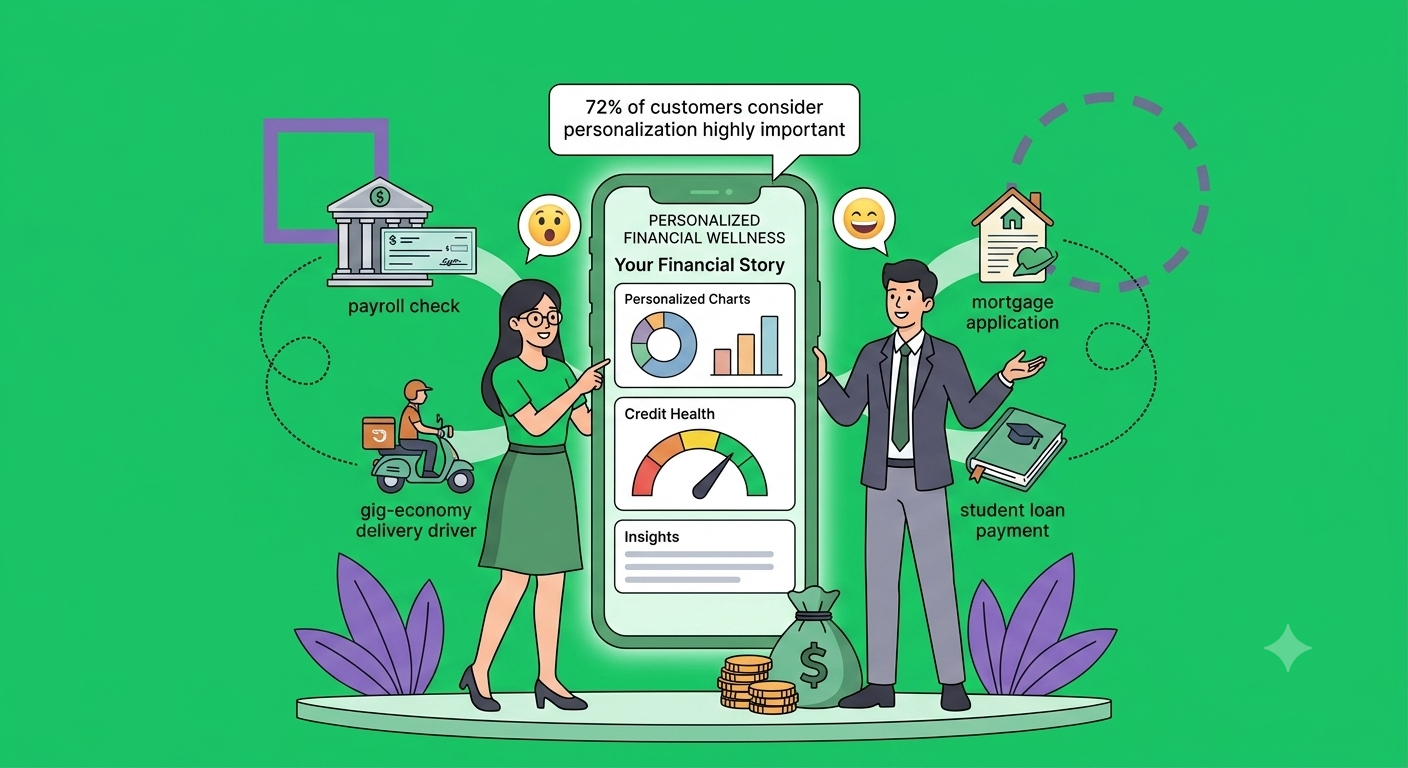
The "one-size-fits-all" approach is quickly becoming a thing of the past. The "one-size-fits-all" approach is quickly becoming a thing of the past. In fact, 72% of customers now consider personalization highly important in financial services. Today, people aren't just looking for a bank; they’re looking for a financial partner that actually understands their unique story—their goals, their hurdles, and their daily reality.This shift toward personalized financial services is changing how banks and lenders talk to their customers.What Does "Personalized" Actually Mean?At its heart, personalized financial wellness isn’t about generic budgeting tips. It’s about using a person’s own specific financial data to give them advice and products that actually fit. Instead of reactive "you spent too much," it’s proactive guidance that helps improve a user's financial health in real-time.But how do you get this level of detail without making things complicated or risky? That’s where a robust data infrastructure comes in.From Demographics to Individual InsightsFor a long time, financial institutions had to rely on broad categories and standardized models. But those often miss the small, important details that make up a person's life. For example, a young professional paying off student loans has completely different needs than a business owner, even if they earn the same amount.Traditional methods of checking someone's background—like waiting days for manual documents—often lead to missed opportunities and frustrated customers. Modern users expect their financial apps to be as intuitive and tailored as their social media feeds.The Role of Consumer-Permissioned DataTo bridge this gap, we need to move toward consumer-permissioned data. This simply means letting the user take the lead. By giving them a secure way to share their own employment and income data, they can prove their creditworthiness instantly.Using tools like the Smile Wink SDK, users can connect directly to their payroll or gig platforms. This gives lenders a "smile-worthy" experience that is:Verified at the Source: No more guessing or manual entry; the data comes straight from the employer or government system.Real-Time: Financial situations change. Real-time access ensures decisions are based on what’s happening now, not six months ago.Privacy-First: Because it’s user-authorized, it builds trust and stays fully compliant with data privacy regulations.Why This Matters for EveryoneWhen we talk about financial wellness, we’re really talking about financial inclusion. One of the biggest hurdles for people who are underbanked is a lack of "traditional" credit data. According to the World Bank Global Findex,millions of adults worldwide still lack access to formal financial services.By moving away from rigid models and embracing a more human, data-driven approach, we can create a financial system that’s more inclusive, transparent, and—most importantly—built for the individual.
- June 29, 2026
- June 29, 2026