

- December 8, 2021
- December 8, 2021
Philippines' Gig, Internet Economies Grew the 'Fastest' Driven by Pandemic Restrictions
Internet economy refers to trends across different sectors like e-commerce, online media, transport and food, online travel, digital financial services, health tech, edtech, among others. Gig economy, however, is just one of several activities happening within the internet economy pertaining mostly to labor that involves temporary and more flexible jobs. They are done by people engaged as short-term, independent contractors like personal shoppers, food delivery drivers, courier drivers, to name a few. Reports showed pandemic restrictions caused massive unemployment in 2020 wiping out 1.7 million wage and salary jobs in the 12 months to January 2021, resulting in a 15-year high of 10.3% unemployment rate or a total of 4.5 million jobless Filipinos. The crisis, however, accelerated the growth rate of Filipinos venturing into remote work and freelancing which led to the sudden rise of the Philippine gig and internet economies. Strict quarantine measures created a domino effect of developments like increase in internet usage and patronage of various digital platforms. Mandated lockdowns forced people to work, study, and eat their favorite foods from restaurants and fastfood chains at home, all made possible with the existence of digital platforms such as online shopping sites Lazada and Shopee, and delivery services providers Food Panda, Lalamove, Grab, Angkas and the like. Fast Growth Rates Two separate reports on internet and gig economies highlighted the Philippines as the fastest growing in the region and the world. A report by Google, Temasek, and Bain & Co, cited that e-commerce and food delivery services accelerated the fast growth of overall internet economy in the Philippines in terms of gross merchandise value (GMV) projected to likely reach $40 billion in value by 2025. The Philippines’ GMV is estimated to reach $17 billion this year, an increase of 93% from a year ago, due to government initiatives, mass digital adoption, and double-digit growth in sectors such as food delivery services. The Philippines also added 12 million new digital consumers since the pandemic started in March 2020. As for the Philippines' digital gig economy, the report by US-based payment platform Payoneer, dubbed: "Freelancing in 2020: An Abundance of Opportunities", showed the Philippine freelancing industry grew the fastest globally since the country's year-on-year freelance revenue growth on the first half of 2020 tripled at 208% outranking India (160%), Japan (87%), Australia (86%), and Hong Kong (79%). E-commerce, Delivery Platforms Boom The Philippines' top online shopping markets or E-commerce sites Lazada and Shopee, including quick-commerce (Q-commerce) delivery platform foodpanda, all improved their business performances amid the crippling pandemic regulations. Lazada Philippines COO Carlos Barrera said both the company's sales and orders increased 2.5 times at present compared to pre-pandemic levels, adding that e-payments adoption also surged with digital payments up three to four times during the same period. Lazada's number of sellers also increased more than three times, or a total of over 120,000 active sellers on the platform. Shopee Philippines meanwhile, was ranked number one most visited e-commerce and shopping website last October followed by Lazada and Amazon. The digital platform recently earned a new record of selling over two billion items in a single day, and r
- December 8, 2021
- December 8, 2021
- November 19, 2021
- November 19, 2021
What is an API?
What is an API and how does it work? Watch below video as our CPO, Jan Pabellon explains what APIs are and how they work in an excerpt from a Webinar we held last November 18, 2021 on how customers can get started with Smile API. Find out more about APIs and how they work by joining us in our next Webinar! https://youtu.be/xBFwZ55mE4M
- November 19, 2021
- November 19, 2021
- November 19, 2021
- November 19, 2021
What is Smile API?
Watch an excerpt from an online Webinar we did last November 18, 2021 in which our CEO, Jerome Eger, explains what Smile API is, particularly how we can help solve problems commonly experienced by many financial services and financial technology companies. He also went into detail about what differentiates Smile from other solutions out there for KYC, identity and employment verification, and traditional credit scoring. https://youtu.be/WiO3TSeUayI
- November 19, 2021
- November 19, 2021
- November 12, 2021
- November 12, 2021
CreditEase, Plug and Play invest in Philippine fintech startup Smile API
- MANILA, Philippines, November 12, 2021 – CreditEase, a China-based diversified conglomerate with a global footprint; and Plug and Play APAC, a tech-focused venture capital firm, made significant investments in Smile API, a newly-launched information infrastructure startup company in the Philippines opening up new opportunities for financial inclusion among the underbanked and unbanked by means of leveraging on employment data especially among freelancers and gig workers. Both investors backed Smile API seeing great potential in the startup's Application Programming Interface (API) designed to bring wider financial inclusion by interconnecting data from businesses, workers, banks and fintech firms to its digital platform, a first of its kind in the Asia Pacific (APAC) Region. Temporary workers in today's growing gig economy are the target end-users of Smile API like personal shopper, courier delivery person, drivers in the rideshare and food delivery businesses, tasker, pet sitter, to name a few. Kevin Aok, Head of Strategic Investment and M&A from CreditEase, explains why Smile API is eyeing the Philippines first: "We are looking for markets with a higher potential growth rate. Many Filipinos have stable income and the Philippines is largely English-speaking." Ziheng Li, Senior Ventures Analyst at Plug and Play Singapore, shares why Smile API is the right API for the region at this time: "Unlike other global markets such as the US and China, where employer data APIs are common, there is no API or service similar to Smile API in the region." Founded only last April, Smile API as a digital platform sets the stage for Open Finance, which is a more inclusive model than Open Banking. Compared to open banking, open finance solves the problem of accessing primary employment data instead of bank data, bridging the gaps in the gaining of financial products and services by the unbanked, like the gig workers in particular. Smile API CEO Jerome Eger discloses the company continues to build and enhance its information infrastructure since receiving the new capital in June to better serve more clients in the Philippines and Southeast Asia. Eger points out, "What we offer becomes not just a win but a win-win-win solution for businesses, their employees, and mostly for third-party providers like banks, financial institutions, and other vendors whose services are made more accessible to potential customers." Eger cites Smile API empowers people to have their own data, and to use that data for their own good. For the end users for example, wallets, loans, insurances, digital bank accounts and many more applications become available through a simple but clear white labeled interface within the client application using the Smile API infrastructure, all while keeping the end user in full control of what data is shared and with whom. According to Eger: "Focusing on employment data enables modern applications with the needed identity, employment and financial information of not just those who have access to banks and financial services, but also those without, catering to a wider range of clients." Smile API for instance helps fast track the loan or financing application process by facilitating approval (or rejection) within just a few seconds. In so doing, Smile API delivers significant value to workers who need to secure financial and/or related services; employers who can recover oper
- November 12, 2021
- November 12, 2021
- October 18, 2021
- October 18, 2021
Smile API expands APAC reach with PH launch
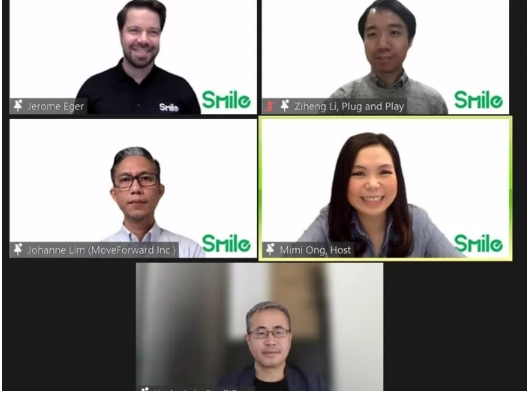
Applying for a loan or financing, whether it's for a car, a business, a house, etc. is a tedious, time-consuming process that requires the heavy involvement of the applicant, their employer, and the concerned financial institution or vendor. - Top row, from left: Smile API CEO Jerome Eger; Senior Ventures Analyst at Plug and Play Singapore Ziheng Li; Middle row, from left: MoveForward Inc. CEO Johanne Lim; Event host and media personality Mimi Ong; Bottom row: Head of Strategic Investment and M&A from Credit Ease, Kevin Aok. Among the first of its kind in the APAC region, Smile API is a digital platform that fast tracks the loan or financing application process by facilitating approval (or rejection) within just a few seconds. In so doing, Smile API delivers significant value to workers who need to secure financial and/or related services; employers who can recover operational time lost to the cumbersome paper trail; and financial institutions that can experience fast, secure transactions in the many moribund application procedures. During the recent company launch in Manila, Smile API CEO Jerome Eger explains the all-too-common situation that bogs down businesses: "We did a survey and found that on the average, for every 100 employees in any given company, there are three to five requests for certificates of employment per week. A person in HR handles this, and it takes company time that can be better used for other business matters. While they need to do this, this process has no value for the employers." Employee-owned data Eger adds, "What we offer becomes not just a win but a win-win-win solution for businesses, their employees, and mostly for third-party providers like banks, financial institutions, and other vendors whose services are made more accessible to potential customers." Individuals register first through the Smile-API-using companies they regularly deal or interact with. They agree to transmit their encrypted employment data which then passes from their employer through Smile API to the bank or vendor in seconds, when they apply for loans, financing, deferred payment terms, employment, or financial services. It is important to note that this is a one-time transaction. Smile API gets the encrypted data from the employer, and passes it on to the institution or the vendor. It does not hold on to the data afterwards. This process happens in seconds, and the applicant, their employer, and the related banks are spared the loss of unnecessary manhours and effort, as well as the stress that comes with waiting for (or working towards) the approval which may or may not be given. Smile API's platform was conceived from a simple, yet important truth that affects virtually everyone, especially the workforce, without them knowing it. People can never fully control their personal and employee data. Their employment data---the most relevant to financial institutions, vendors, or even potential new employers---will always need to be obtained from and verified by third parties through documentation, like certificates of employment, pay slips, proofs of billing, bank statements, credit card statements, or even academic transcripts of records. Investor funding To escape this cycle of inefficiency, Eger asserts that the individual must realize that "having access to data is a basic right. Your data is very important, as data is the oil of the 21st century. The difference
- October 18, 2021
- October 18, 2021
- August 18, 2021
- August 18, 2021
How Smile is Enabling Financial Inclusion with APIs
Why Financial Inclusion Matters Financial inclusion is one of the most important things that can happen to a society. It means enabling access to financial services to those who were previously denied access to them. It is not just about giving people access to banking services, but it is ultimately about giving them more control over their lives, providing them with more opportunities, and helping them better prepare for uncertainties and risk. By giving people access to financial services, they can make better financial decisions, better manage their liabilities and obligations, borrow money for emergencies, save for retirement, provide education for their children, and achieve their dreams and aspirations. Besides social benefits, financial inclusion also matters for economic development. It improves the quality of life for everyone. It enables transparency, reduces graft and corruption, and reduces poverty. It helps grow economies by creating business efficiency and improved resiliency. In fact, the UN has identified financial inclusion as being a key enabler in their 2030 Sustainable Development Goals. it is featured as a key element in eight of the seventeen goals which includes eliminating poverty, achieving food security, promoting equality, achieving good health and well-being. These goals for sustainable development according to the UN, would be impossible without access to affordable financial services. How APIs Provide the Foundation for Financial Inclusion to Happen APIs provide a new way of accessing financial services. Financial services were traditionally provided by banks and other traditional financial institutions. It used to be that these services were costly to develop and operate, and often saddled with inefficiencies, making it economically infeasible to bring and offer to the lowest economic segments of society. However, with technology, this is quickly changing. Technologies such as mobile devices, cloud computing, robotic process automation, and artificial intelligence have transformed how these services are being conceived, managed, and delivered. The glue that links these technologies together are something called “APIs” or “Application Programming Interfaces.” APIs are really just a set of tools that allow for systems to connect with one other easily: to be able to exchange data or orchestrate processes or workflows. With APIs, these data exchange methods, processes and workflows can be done in an automated way, at much less cost, In addition, they provide better consumer experiences, enabling faster and more engaging transactions than traditional means. A good example would be how payments are done today. In the last few months, you have probably shopped or ordered food online. It is likely that you have paid for these transactions via one of the various electronic, contactless payment methods out there—such as an e-wallet, online bank transfer, or a credit card. All of these are made possible by APIs. The Rise of the API Economy The API economy basically refers to the use of APIs to enable innovation and new business models. By making data and services more accessible and flexible, new products and services can be quickly brought to market. By using APIs, new business can launch and rapidly scale up in ways that were simply not possible before. Such is the case of Twilio which is revolutionizing telecommunications by allowing developer
- August 18, 2021
- August 18, 2021